

Article Summary
● IELTS Writing relies on strong academic vocabulary, accurate linking words, and logical connections between sentences to demonstrate language ability.
● In Academic Task 1, you need vocabulary for describing trends such as increase, decrease, and fluctuate.
● In General Training Task 1, you need formal and personal letter phrases such as I am writing to inform you.
● In Task 2, you need opinion and argument phrases such as From my perspective and It can be argued that.
● Across all tasks, you need linking words such as however, therefore, and moreover.
● It is better to learn each word with a complete example sentence rather than memorizing only its translation.
IELTS Writing vocabulary falls into four main categories: Task 1 vocabulary, Task 2 vocabulary, linking words, and academic vocabulary — and each category serves a different purpose in the test.
Building a strong IELTS vocabulary means knowing how to connect your ideas, describe data, express your opinion, and write clear, persuasive sentences without repetition or unnecessary filler.
In this guide, you’ll learn the most useful IELTS Writing words and phrases, organized by purpose, along with an academic IELTS vocabulary PDF list and practical examples showing how to use them in writing.
Essential IELTS Writing Vocabulary
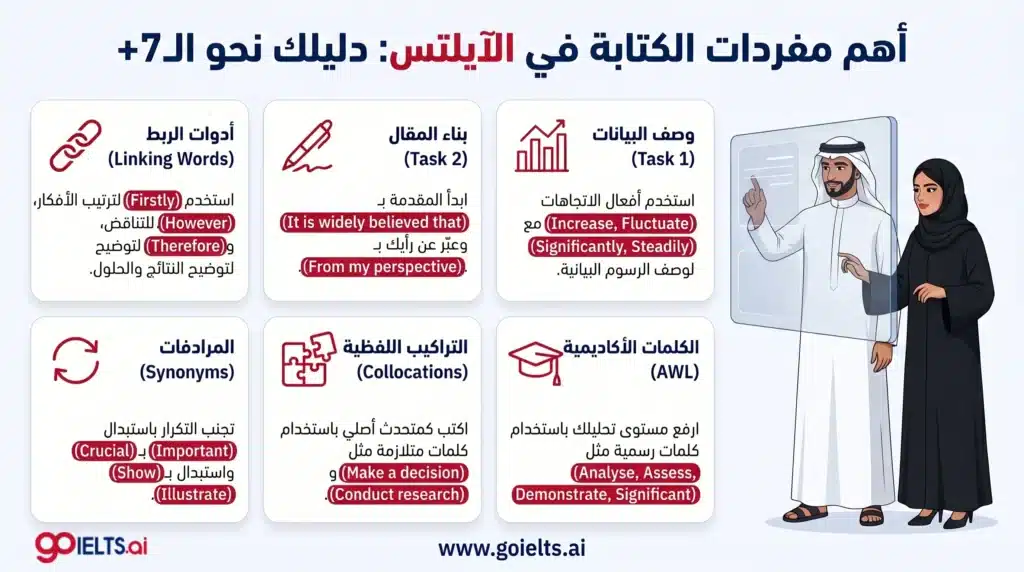
IELTS Writing vocabulary can be divided into four main groups, each serving a different function depending on the task and test type.
Understanding these groups helps you choose the right word for the right context instead of memorizing a long list without knowing when to use it.
Below is a practical classification of the most useful IELTS Writing vocabulary for Task 1 and Task 2, linking and cohesion, plus a selection of academic IELTS vocabulary for PDF study:
First: Vocabulary for IELTS Writing Task 1
-
Graph and Chart Vocabulary (Academic)
These words are used in IELTS Academic Writing Task 1 (IELTS Academic Task 1) when describing a graph, chart, or table.
They are essential for describing trends and changes accurately and clearly.
| Word / Phrase | Meaning | Use | Example in a Sentence |
|---|---|---|---|
| Increase / Rise / Grow | increase / rise / growth | to describe an increase | Sales increased significantly in 2023. |
| Decrease / Fall | decrease / fall / decline | to describe a decrease | Prices fall sharply after 2020. |
| Fluctuate | fluctuate | for repeated changes | The rate fluctuated throughout the year. |
| Remain stable | remain stable | for stable values | Figures remained stable at 40%. |
| Peak / Reach a peak | reach a peak | for the highest point | Production peaked in July. |
| Decline gradually | decline gradually | for a gradual decrease | Numbers declined gradually after 2015. |
| Dramatic change | dramatic / major change | to describe a noticeable change | There was a dramatic change in exports after 2010. |
| Steady growth | steady growth | to describe a consistent increase | The company showed steady growth over five years. |
| Sharp fall | sharp fall | to describe a rapid decrease | There was a sharp fall in temperatures in December. |
| The proportion of | the proportion of… | for percentages and proportions | The proportion of users rose to 60%. |
Important tip:
When describing graphs and charts use adverbs such as significantly, slightly, rapidly, and steadily to show the degree of change. These adverbs make your description more precise and are easy for the examiner to notice.
Example: The number increased significantly — the figure changed significantly.
-
Map and Process Vocabulary (Academic)
Academic Task 1 can also include maps and process diagrams.
Here are some of the most useful academic IELTS words and phrases for describing maps and processes:
| Word / Phrase | Use | Example in a Sentence |
|---|---|---|
| is located / is situated | describing location | The factory is located near the river. |
| adjacent to / north of | describing direction and proximity | The park is adjacent to the school. |
| has been replaced by | describing changes between two maps | The forest has been replaced by housing. |
| is produced / is generated | describing the beginning of a process | Electricity is produced from solar panels. |
| flows into / leads to | linking stages of a process | Water flows into the main reservoir. |
| is converted into | describing transformation between stages | Heat is converted into usable energy. |
-
Letter-Writing Vocabulary (General Training Task 1)
These phrases are useful when writing formal, personal, or semi-formal letters in IELTS General Training Writing Task 1. The vocabulary you choose depends on the purpose of the letter — such as a request, complaint, or thank-you — and on whether the tone should be formal, semi-formal, or personal.
| Phrase | Meaning | Letter Type | Example in a Sentence |
|---|---|---|---|
| Dear Sir or Madam | Dear Sir/Madam | Formal | Dear Sir or Madam, I am writing regarding my application. |
| I am writing to inform you | I am writing to inform you | Formal | I am writing to inform you of a recent change in my schedule. |
| I would like to request | I would like to request | Formal | I would like to request a refund for my recent order. |
| Please find attached | Please find attached | Formal | Please find attached a copy of my identification documents. |
| I am sorry to hear that | I am sorry to hear that | Personal | I am sorry to hear that you missed the interview. |
| Looking forward to hearing from you | Looking forward to hearing from you | Formal or personal | I look forward to hearing from you at your earliest convenience. |
| Yours faithfully | Yours faithfully | Formal (when you do not know the recipient’s name) | Yours faithfully, Ahmed Al-Ghamdi |
| Yours sincerely | Yours sincerely | Formal (when you know the recipient’s name) | Yours sincerely, Sara Al-Otaibi |
| Best regards | Best regards | Formal or friendly | Best regards, and thank you for your time. |
| Hope you are doing well | Hope you are doing well | Personal | Hope you are doing well and enjoying the holiday. |
Tip: Start your letter with an opening sentence that clearly explains why you are writing, such as: “I am writing to apply for…” or “I am writing to complain about…”
See our IELTS Writing guide for a detailed explanation of the Writing section and its tasks.
Second: Vocabulary for IELTS Writing Task 2
-
Essay-Writing Vocabulary
In Task 2, whether you take Academic or General Training, you are asked to write an essay discussing a specific issue, opinion, or problem.
Here are useful IELTS Writing words and phrases that can help you organize your essay and present your arguments clearly and persuasively:
| Phrase | Meaning | Use | Example in a Sentence |
|---|---|---|---|
| It is widely believed that | It is widely believed that | to begin a general introduction | It is widely believed that education shapes society. |
| From my perspective | From my perspective | to express a personal opinion | From my perspective, this policy is ineffective. |
| The main reason is that | The main reason is that | to explain reasons | The main reason is that funding is severely limited. |
| One possible solution could be | One possible solution could be | to suggest solutions to a problem | One possible solution could be investing in public transport. |
| On the contrary | On the contrary | to challenge an opposing view | On the contrary, studies show the opposite trend. |
| In terms of | In terms of | to specify the aspect being discussed | In terms of cost, renewable energy is now competitive. |
| It can be argued that | It can be argued that | to present an arguable point | It can be argued that technology reduces job opportunities. |
| To some extent | To some extent | to qualify an opinion | This statement is true to some extent. |
| As far as I am concerned | As far as I am concerned | to express a clear personal opinion | As far as I am concerned, prevention is better than cure. |
| In conclusion | In conclusion | to begin the conclusion paragraph | In conclusion, both factors play a significant role. |
Tip: Use these phrases in specific parts of your essay:
- In the introduction: It is widely believed that
- In the body: The main reason is that…
- In the conclusion: In conclusion, it can be said that…
If you want to learn how to use these phrases correctly within an essay structure, read our guide to the most important IELTS Writing Task 2 tips and strategies (ielts writing task 2 tips and tricks)
Third: Linking Words and Cohesion for IELTS
Linking words are one of the most important tools in IELTS Writing because they make your ideas more coherent, logical, and easier to follow in both Task 1 and Task 2.
- For addition: Moreover, In addition
- For contrast: However, On the other hand
- For results: Therefore, As a result
- For examples: For example, For instance
Tip: Avoid repeating the same linking word in multiple paragraphs. Overuse can weaken your Coherence & Cohesion score.
For a full list organized by function, including the differences between Task 1 and Task 2 linking devices, see our complete guide: IELTS linking words.
If you need a complete essay structure, you can also use our collection of ready-made IELTS Writing templates for every Task 1 and Task 2 question type as a practical IELTS Writing reference.
read our guide to Frequently Used Words in IELTS
Fourth: Essential IELTS Vocabulary PDF (Academic Word List — AWL)
One of the best ways to develop your IELTS Writing vocabulary is to study high-frequency academic word lists.
Below, we introduce a list of 500 useful IELTS words based on the official Academic Word List (AWL), developed by researcher Averil Coxhead.
The list is divided by topic into five groupsand each group contains 100 words commonly used in IELTS Writing with difficulty increasing gradually from Level 1 to Level 5.
Here are 12 common words that frequently appear in IELTS vocabulary lists:
| Word / Phrase | Meaning | Example in a Sentence |
|---|---|---|
| analyse | analyse | We can analyse the data in two ways. |
| assess | assess | Examiners assess your vocabulary range. |
| demonstrate | demonstrate | The graph demonstrates a sharp rise. |
| evidence | evidence | There is strong evidence for this view. |
| factor | factor | One key factor is access to education. |
| impact | impact | Technology has a significant impact. |
| indicate | indicate | The data indicates a steady decline. |
| significant | significant / important | There was a significant increase in usage. |
| source | source | The main source of pollution is transport. |
| structure | structure | A clear structure improves your score. |
| vary | vary | Results vary across different age groups. |
| establish | establish | Research has established a clear link. |
Download now our translated IELTS vocabulary PDF list to get 560 useful IELTS words ready to study.
How Can GoIELTS.ai Help You Improve Your Writing Vocabulary?
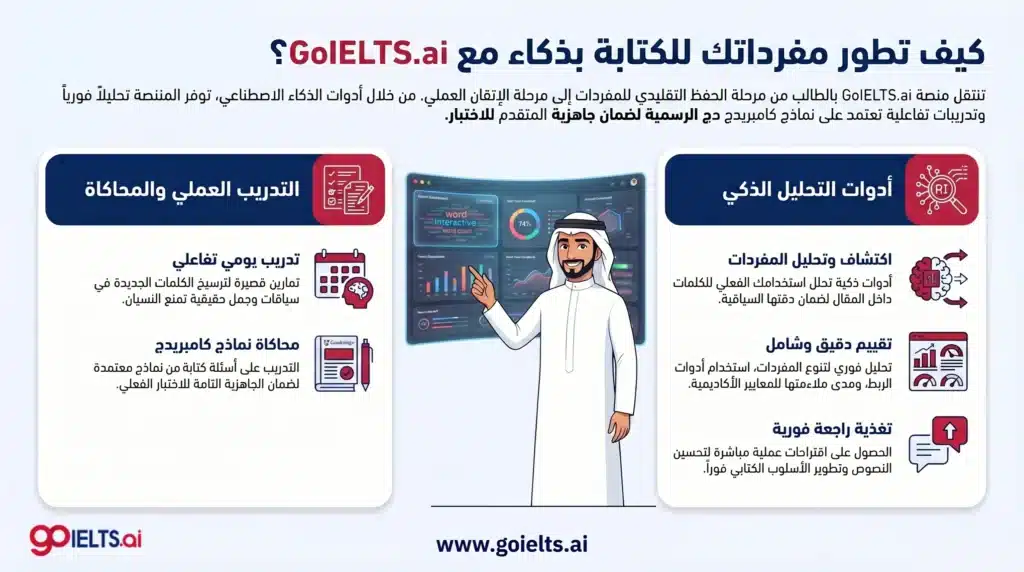
The platform GoIELTS.ai is a smart tool that helps you improve your IELTS Writing performance through practical training in using vocabulary accurately and naturally.
Here are some of the key ways the platform helps you develop your IELTS Writing vocabulary:
-
Smart vocabulary analysis:
The platform uses AI-powered tools to analyze the vocabulary in your writing and identify areas where you can use more accurate or varied language.
When you write an essay on the platform, the system evaluates vocabulary range, contextual accuracy, and the use of linking devices, then gives you practical suggestions for improvement.
-
Flexible practice to apply new vocabulary regularly:
The GoIELTS platform lets you practice IELTS Writing daily through short, interactive exercises that help you use important vocabulary in realistic sentences and contexts, making it easier to remember.
-
Improve your IELTS Writing score:
Moving from simply memorizing IELTS Writing words to using them intelligently in realistic writing tests based onIELTS Academic sample testsor IELTS General Training sample tests can improve your chances of achieving a higher score in the IELTS test.
Visit our complete IELTS PDF library (free IELTS PDFs, sample tests, and practice materials)
Why Vocabulary Matters for Your IELTS Writing Score
Vocabulary is important in the IELTS Writing section because it affects several parts of your performance:
1. Vocabulary accounts for 25% of your Writing score
Learning useful IELTS Writing vocabulary is an essential step toward achieving a high Writing score because vocabulary accounts for 25% of the IELTS Writing score through the Lexical Resource criterion, one of the four IELTS Writing assessment criteria used by examiners. Lexical Resource does not simply measure how many words you know; it assesses how accurately, flexibly, and appropriately you use a range of vocabulary in context.
2. Improve Coherence & Cohesion
Using appropriate linking words also affects Coherence & Cohesion, another major IELTS Writing criterion that measures how logically and smoothly your ideas are organized and connected.
3. Avoid repetition in your writing
Building a varied IELTS Writing vocabulary helps you avoid repeating the same words. Repetition can lower your Lexical Resource score even when your grammar is correct. Learning synonyms and natural collocations makes your writing sound more fluent and authentic.
4. Support a higher overall IELTS score
Developing your vocabulary is one of the most important ways to improve your overall IELTS performance. Many of the words you learn for Writing can also strengthen your IELTS Speaking because they demonstrate vocabulary range and your ability to express ideas fluently in the IELTS Speaking test.
Also read: Latest IELTS Writing topics
5 Common IELTS Writing Vocabulary Mistakes and How to Avoid Them
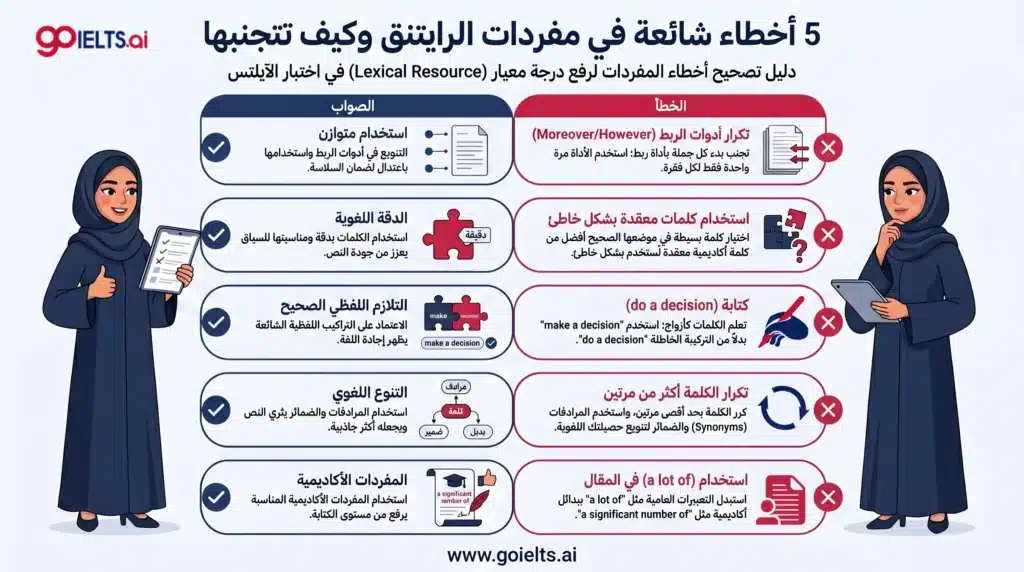
Many learners lose marks not because of grammar, but because of recurring vocabulary mistakes. Here are some of the most common patterns:
| Common Mistake | Better Approach | Why It Matters |
|---|---|---|
| 1. Starting every sentence with Moreover / However | Use linking devices selectively within each paragraph | Overuse can weaken Coherence & Cohesion |
| 2. Using difficult words in the wrong context | Accuracy matters more than complexity | A simple word used correctly is better than an academic word used incorrectly |
| 3. Repeating the same word several times in one paragraph | Use a synonym, pronoun, or different structure | Repetition can reduce your Lexical Resource score |
| 4. Using incorrect collocations such as “do a decision” | make a decision/conduct research | Learn natural word combinations, not isolated words |
| 5. Using overly informal vocabulary in Task 2, such as “a lot of” | a significant number of/a considerable amount | Task 2 generally requires a more formal academic style |
Download now free IELTS PDF books for preparation and practice
Tips to Strengthen Your IELTS Writing Vocabulary
1. Focus on quality, not quantity:
It is better to learn a smaller number of words well than to memorize a large vocabulary list without understanding how each word is used.
2. Use new words in realistic sentences:
Do not memorize words only for the test. Use them in short paragraphs and meaningful sentences so you learn their natural context.
3. Review vocabulary regularly:
Revisit the words you have learned from time to time so you can recall them confidently under test pressure.
4. Use Writing vocabulary in Speaking too
Many words you learn for Writing can also be used in Speaking. This gives you one practical vocabulary bank that can help you in develop both Speaking and Writing skills. You will also find overlap with the vocabulary in our IELTS Listening vocabulary guide which includes words that are useful across different skills.
5. Learn synonyms to avoid repetition
Strong IELTS Writing avoids unnecessary repetition by using appropriate synonyms and alternative phrasing.
For example, if you need to repeat a word several times, consider suitable IELTS synonyms such as:
- Important → essential/vital/crucial
- Show → demonstrate/illustrate/reveal
- Approximately → roughly / around / nearly / about
Using synonyms in IELTS Writing is not only about style; it is part of the range and flexibility that examiners assess under Lexical Resource.
6. Learn Common Collocations:
Collocations are words that naturally occur together in English, the way fluent speakers typically use them.
For example:
- We say make a decision (to make a decision), not do a decision;
- and we say reach a conclusion (to reach a conclusion), not arrive to a conclusion;
- and we say conduct research (to conduct research), not do research.
Learning collocations is especially important in IELTS Writing because they make your language sound more natural and precise. They also show that you understand how words are actually used in context rather than simply knowing their dictionary meanings.
Also read how to improve your IELTS Writing skills more effectively and efficiently.
In conclusion,
IELTS Writing vocabulary is not simply a list to memorize before the test. It is a set of language tools that you build gradually by using words in meaningful sentences and real contexts.
When you combine this vocabulary with effective IELTS Writing strategies and techniques and regular daily practice, you can make noticeable progress in your ability to handle different IELTS Writing tasks.
Using the same vocabulary in Speaking gives you an additional advantage because it helps you express ideas more fluently and clearly in English.
By applying Writing strategies such as planning, reviewing, and varying your vocabulary, and practicing regularly through the GoIELTS.ai you can approach the Writing section with much greater confidence.
About the Content Team at GoIELTS
GoIELTS creates specialized content for IELTS with contributions from writers experienced in education and test preparation.
We follow clear editorial standards for accuracy and quality — read our Editorial Policy


Related Posts

Frequently Asked Questions
The most useful IELTS Writing words are those that help you express causes, results, comparisons, and opinions accurately.
Examples include:
- Analyze
- Discuss
- Therefore / As a result
- In contrast / On the other hand
- Significant / Considerable
These words and phrases help you write coherent, well-organized sentences and can strengthen your Lexical Resource score.
- Read the question carefully and identify the task type.
- Use vocabulary that matches the type of writing:
- For Academic Task 1 data descriptions: use words such as increase, decline, and fluctuate.
- For Task 2 essays: use words such as opinion, argument, evidence, and conclusion.
- Use linking words appropriately, such as Moreover, However, and In addition.
- Check your spelling and grammar.
- Use a varied vocabulary without forcing difficult words or repeating the same expressions.
- Academic Task 1: You need vocabulary for describing trends, charts, and data, such as rise, fall, percentage, and proportion.
- General Training Task 1: You need vocabulary for formal and informal letters, such as I am writing to inform you and I would like to request.
- Task 2: Vocabulary focuses more on opinions, arguments, solutions, and comparisons, such as It is widely believed that, one possible solution, and on the contrary.
There is no fixed number of words required for a good IELTS Writing score. Your score depends more on how accurately and appropriately you use vocabulary and how clearly you organize your ideas.
As a practical target, building a working vocabulary of around 300 to 500 useful words and phrases can give you a solid foundation, provided you focus on correct usage and avoid grammar and spelling errors.
No. Difficult vocabulary is not automatically better. What matters most is choosing the right word for the context, using it accurately, and showing enough variety without unnecessary repetition. A simple word used correctly is better than an advanced word used incorrectly.
To avoid repetition in IELTS Writing:
- Use appropriate synonyms, such as important → significant / crucial.
- Use different forms of the same word when suitable, such as noun and verb forms.
- Vary your sentence structure and use linking devices naturally rather than repeating the same expression.
If you are taking IELTS General Training, Task 1 is a letter, so letter-writing vocabulary is important.
If you are preparing for IELTS Academic, letter-writing vocabulary is much less relevant because Academic Task 1 focuses on visual information such as graphs, charts, maps, and processes.
Yes. You can download free vocabulary resources such as the GoIELTS Academic Word List PDF, based on commonly used academic vocabulary from the Academic Word List (AWL).
Yes. Many useful IELTS words can support both Writing and Speaking, especially vocabulary for expressing opinions and linking ideas.
For example, phrases such as I believe, in my opinion, and from my perspective, as well as linking expressions such as however, therefore, and on the other hand, can also help you organize your ideas in Speaking.
However, Writing generally requires a more formal and academic style, while Speaking should sound more natural and conversational.
A practical rule is to use linking words selectively rather than starting every sentence with one. In many paragraphs, one clear transition is enough to introduce the main relationship between ideas.
If every sentence begins with Moreover or Furthermore, the writing can sound mechanical. Instead, use a linking word where it is genuinely needed, then create cohesion through pronouns and reference phrases such as “this approach” or “such measures”.
This is closer to what IELTS examiners look for under Coherence & Cohesion.
Linking Words are one part of the broader category of Cohesive Devices, but they are not the same thing.
- Linking Words are explicit connectors such as However, Therefore, and In addition. They show the logical relationship between ideas.
- Cohesive Devices also include pronouns such as it and they, reference words such as this and these, and substitution expressions such as the former and the latter.
Using both types helps your writing flow naturally instead of relying on repeated transition words.
About the Content Team at GoIELTS
GoIELTS creates specialized content for IELTS with contributions from writers experienced in education and test preparation.
We follow clear editorial standards for accuracy and quality — read our Editorial Policy
Related Posts
GoIELTS is an independent training platform specializing in IELTS preparation and is not affiliated with any official organization that owns or administers the IELTS test. The content is provided for educational and informational purposes only and reflects our team’s experience and the latest information available at the time of publication. Information may change without notice. Any use of the information is at the reader’s own responsibility, and results vary depending on each learner’s level and effort. For the latest official requirements, we recommend checking the official IELTS website and the relevant scholarship or sponsoring authority. — Full Disclaimer