

Article Summary
● IELTS uses a 0–9 Band Score scale. Listening, Reading, Writing, and Speaking each receive a separate score, and the Overall Band Score is the average of the four.
● Listening and Reading are scored from 40 correct answers and converted to Band Scores. Academic and General Training Reading use different raw-score conversions.
● Writing and Speaking are assessed with four detailed criteria. Writing Task 2 carries more weight than Task 1.
● Overall scores are rounded to the nearest whole or half band: an average ending in .25 rounds up to the next half band, while .75 rounds up to the next whole band.
● There is no universal IELTS pass score. Required bands depend on the university, scholarship, employer, professional body, or immigration program.
IELTS band scores are one of the first things test takers want to understand before the exam: What is IELTS scored out of? What is the highest IELTS score? What score do universities, scholarship programs, employers, or immigration authorities usually require?
In this guide, you will learn how IELTS scores are calculated, how raw scores in Listening and Reading are converted into Band Scores, how Writing and Speaking are assessed, how the Overall Band Score is rounded, and what each score from 0 to 9 means.
You will also find practical score tables for IELTS Academic and General Training, an explanation of Band Descriptors, One Skill Retake, and approximate comparisons with CEFR, TOEFL iBT, STEP, PTE Academic, and the Duolingo English Test.
IELTS Band Score Table: What Does Each Score Mean?
IELTS uses a 0–9 band scale. Each band describes a level of English proficiency. Whole and half bands such as 6.5 and 7.5 can be reported.
| Band Score | Skill Level | What It Means |
|---|---|---|
| 9.0 | Expert User | Fully operational command of English, with appropriate, accurate, and fluent use of the language. |
| 8.5 | Between Very Good and Expert | Very strong performance with only occasional minor inaccuracies. |
| 8.0 | Very Good User | Very good command of English, with only occasional unsystematic inaccuracies or misunderstandings. |
| 7.5 | Between Good and Very Good | Strong operational command with relatively few weaknesses. |
| 7.0 | Good User | Operational command of English, with occasional inaccuracies and misunderstandings in some situations. |
| 6.5 | Between Competent and Good | Generally effective communication with some errors or limitations in more complex situations. |
| 6.0 | Competent User | Effective command of English despite some inaccuracies, inappropriate usage, or misunderstandings. |
| 5.5 | Between Modest and Competent | A reasonable working command of English, but with noticeable limitations and mistakes. |
| 5.0 | Modest User | Partial command of English; able to cope with overall meaning in many situations but likely to make frequent mistakes. |
| 4.5 | Between Limited and Modest | Basic communication is possible, but understanding and expression remain limited. |
| 4.0 | Limited User | Basic competence is limited to familiar situations, with frequent problems in understanding and expression. |
| 3.5 | Between Extremely Limited and Limited | Very limited ability to communicate beyond familiar and predictable situations. |
| 3.0 | Extremely Limited User | Can understand and communicate only general meaning in very familiar situations. |
| 2.5 | Between Intermittent and Extremely Limited | Communication is severely restricted and understanding is very limited. |
| 2.0 | Intermittent User | Great difficulty understanding spoken and written English. |
| 1.5 | Between Non-User and Intermittent | Almost no functional ability beyond isolated words and very basic expressions. |
| 1.0 | Non-User | No ability to use English beyond a few isolated words. |
| 0 | Did Not Attempt the Test | The test taker did not answer the questions. |
IELTS does not have one universal pass or fail score. A Band 6.0 may meet one institution’s requirement while another program may require 6.5, 7.0, or a specific minimum in each skill.
What Is a Passing IELTS Score?
There is no single “passing score” for IELTS. Each university, scholarship provider, employer, professional regulator, or immigration program sets its own requirement. Always check the exact requirement for the organization you are applying to.
Understanding IELTS Scores from 0 to 9
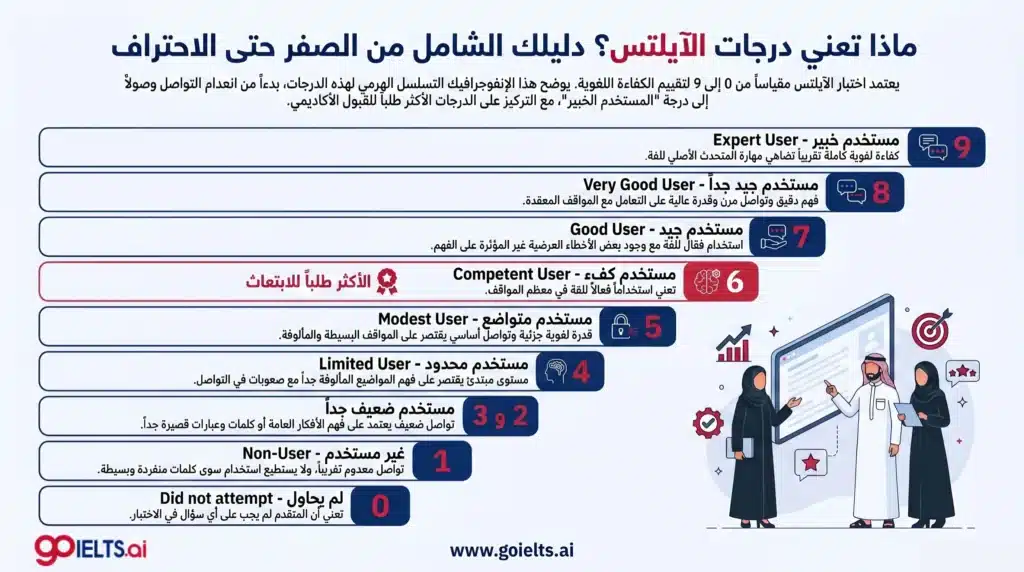
IELTS reports a separate Band Score for each of the four skills:
- Listening
- Reading
- Writing
- Speaking
Your Overall Band Score is calculated from the average of these four skill scores and is reported on the same 0–9 scale.
For the official explanation of the scoring system, you can also review the IELTS scoring guide.
How Is the IELTS Listening Score Calculated?
The IELTS Listening test contains 40 questions. You receive one raw mark for each correct answer, and your raw score out of 40 is converted to an IELTS Band Score.
The exact number of correct answers needed for a particular band may vary slightly from one test version to another. The table below is a practical conversion guide commonly used for preparation.
IELTS Listening Raw Score to Band Score Table
| Correct Answers out of 40 | Approx. Band Score |
|---|---|
| 39–40 | 9.0 |
| 37–38 | 8.5 |
| 35–36 | 8.0 |
| 32–34 | 7.5 |
| 30–31 | 7.0 |
| 26–29 | 6.5 |
| 23–25 | 6.0 |
| 18–22 | 5.5 |
| 16–17 | 5.0 |
| 13–15 | 4.5 |
| 10–12 | 4.0 |
| 8–9 | 3.5 |
| Below 8 | Approximately 0–3.0 |
How Is the IELTS Reading Score Calculated?
The IELTS Reading test also contains 40 questions. Your raw score is the number of correct answers, which is then converted to a Band Score.
The conversion differs between IELTS Academic Reading and IELTS General Training Reading. General Training candidates usually need more correct answers to achieve the same band because the texts are generally less complex.
IELTS Academic Reading Raw Score to Band Score
| Correct Answers | Approx. Band Score |
|---|---|
| 39–40 | 9.0 |
| 37–38 | 8.5 |
| 35–36 | 8.0 |
| 33–34 | 7.5 |
| 30–32 | 7.0 |
| 27–29 | 6.5 |
| 23–26 | 6.0 |
| 19–22 | 5.5 |
| 15–18 | 5.0 |
| 13–14 | 4.5 |
| 10–12 | 4.0 |
| 8–9 | 3.5 |
| 6–7 | 3.0 |
| 4–5 | Approximately 2.5 or below |
IELTS General Training Reading Raw Score to Band Score
| Correct Answers | Approx. Band Score |
|---|---|
| 40 | 9.0 |
| 39 | 8.5 |
| 37–38 | 8.0 |
| 36 | 7.5 |
| 34–35 | 7.0 |
| 32–33 | 6.5 |
| 30–31 | 6.0 |
| 27–29 | 5.5 |
| 23–26 | 5.0 |
| 19–22 | 4.5 |
| 15–18 | 4.0 |
Important: IELTS itself notes that raw-score thresholds can vary slightly from one test version to another, so use these tables as preparation guidance rather than a guaranteed conversion for every test.
How Is IELTS Writing Scored?
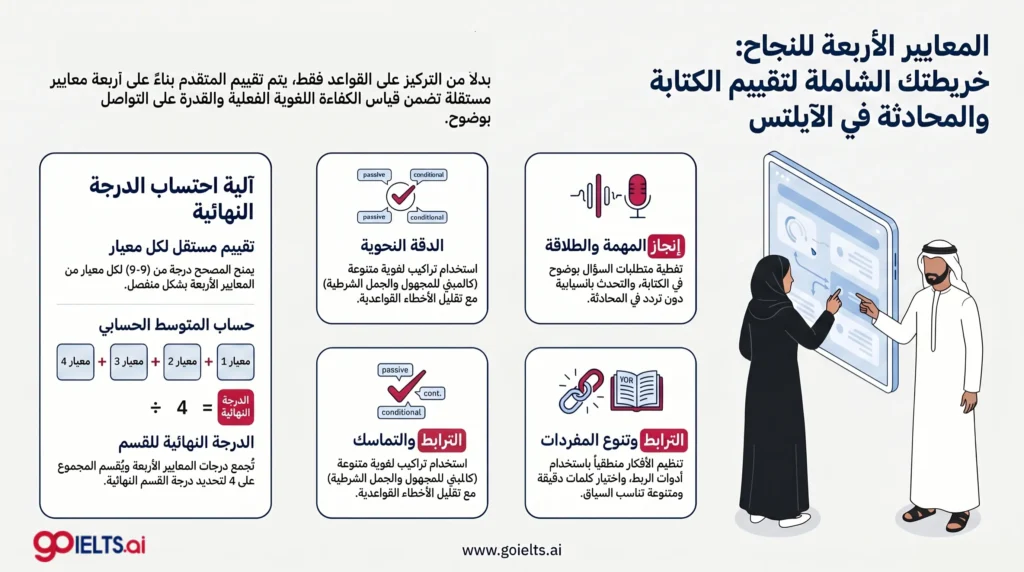
IELTS Writing is assessed by trained examiners using four criteria. Each task is assessed separately, and Task 2 carries more weight than Task 1 in the final Writing score.
IELTS Writing Assessment Criteria
| Criterion | What It Measures |
|---|---|
| Task Achievement / Task Response | How fully and appropriately you answer the task. Task 1 uses Task Achievement, while Task 2 uses Task Response. |
| Coherence and Cohesion | How logically your ideas are organized and how effectively paragraphs and linking devices connect the response. |
| Lexical Resource | The range, accuracy, and appropriateness of vocabulary, including spelling and word choice. |
| Grammatical Range and Accuracy | The range and accuracy of grammatical structures and punctuation. |
In IELTS Writing Task 1, Academic candidates describe visual information, while General Training candidates write a letter. In IELTS Writing Task 2, both versions require an essay of at least 250 words.
Illustrative Writing Criterion Average
Suppose an individual Writing task received the following criterion scores:
| Criterion | Score |
|---|---|
| Task Achievement / Task Response | 6.0 |
| Coherence and Cohesion | 6.5 |
| Lexical Resource | 6.0 |
| Grammatical Range and Accuracy | 7.0 |
The average is:
(6.0 + 6.5 + 6.0 + 7.0) ÷ 4 = 6.375
This illustrates how the criteria contribute to a task score. For the final Writing band, Task 2 carries more weight than Task 1.
How Is IELTS Speaking Scored?
IELTS Speaking is assessed using four equally weighted criteria in both IELTS Academic and General Training.
IELTS Speaking Assessment Criteria
| Criterion | What It Measures |
|---|---|
| Fluency and Coherence | Your ability to speak continuously, organize ideas, and connect them clearly without excessive hesitation. |
| Lexical Resource | The range and appropriateness of your vocabulary and your ability to express or paraphrase meaning. |
| Grammatical Range and Accuracy | The variety and accuracy of grammatical structures you use. |
| Pronunciation | How easy you are to understand, including sound production, stress, rhythm, and intonation. |
Speaking Score Example
| Criterion | Score |
|---|---|
| Fluency and Coherence | 6.0 |
| Lexical Resource | 6.5 |
| Grammatical Range and Accuracy | 7.0 |
| Pronunciation | 6.0 |
The average of the four criteria is 6.375, which illustrates an overall performance around Band 6.5.
How to Improve Your IELTS Band Score with GoIELTS
GoIELTS is an independent IELTS preparation platform. If you want to raise your score, use your current level and target band to build a focused preparation plan.
1. Set a clear target score
Start by checking the exact requirement for your university, scholarship, job, or immigration route. A target of 6.5 is different from a target of 7.5, especially when an organization also requires minimum scores in each skill.
2. Build a study plan around all four skills
Divide your preparation across Listening, Reading, Writing, and Speaking, while spending extra time on the skills that are currently below your target.
3. Use reliable IELTS materials
Practise with reputable sources, including official-style tasks and Cambridge IELTS practice materials, and review the public IELTS assessment criteria for Writing and Speaking.
4. Take full mock tests regularly
Use a full IELTS mock test to practise timing, test stamina, and switching between sections under realistic conditions.
5. Track your progress and learn from mistakes
After each practice test, review which question types, grammar problems, vocabulary gaps, or timing issues cost you marks. Focus your next study sessions on those specific weaknesses.
What Are IELTS Band Descriptors?
IELTS Band Descriptors are detailed assessment criteria used to evaluate Writing and Speaking performance. They explain what examiners look for at different band levels.
Speaking Band Descriptors
- Fluency and Coherence: how continuously and logically you speak.
- Lexical Resource: the range and precision of your vocabulary.
- Grammatical Range and Accuracy: the variety and accuracy of grammatical structures.
- Pronunciation: how understandable your speech is, including stress, rhythm, and intonation.
Writing Band Descriptors
- Task Achievement / Task Response: how fully you address the task and develop relevant ideas.
- Coherence and Cohesion: how logically the response is organized and connected.
- Lexical Resource: the range, precision, and appropriateness of vocabulary.
- Grammatical Range and Accuracy: the range and accuracy of grammar and punctuation.
How Scoring Differs Across the Four IELTS Skills
Listening and Reading
Listening and Reading use raw scores: each correct answer receives one mark, and the total out of 40 is converted to a Band Score.
Writing and Speaking
Writing and Speaking are evaluated using detailed assessment criteria known as Band Descriptors. Examiners award scores for each criterion and use those criteria to determine the skill band.
How to Calculate Your Overall IELTS Band Score
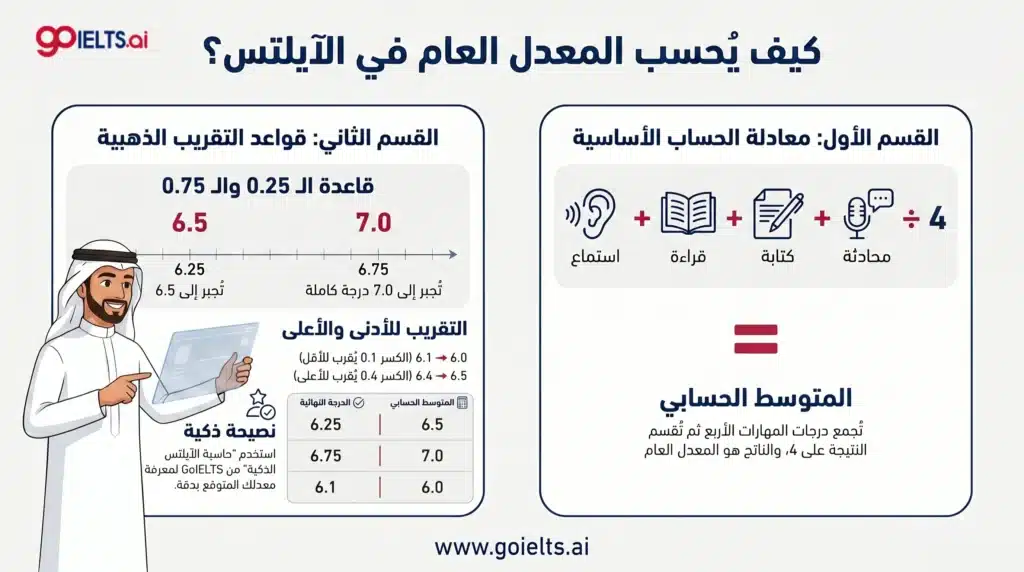
Your Overall Band Score is the average of your four skill scores:
(Listening + Reading + Writing + Speaking) ÷ 4
For example:
- Listening: 6.5
- Reading: 7.0
- Writing: 6.0
- Speaking: 7.0
Average = (6.5 + 7.0 + 6.0 + 7.0) ÷ 4 = 6.625
The reported Overall Band Score is 6.5.
Use the GoIELTS Band Score Calculator to calculate your estimated overall score.
IELTS Overall Band Score Rounding Rules
The Overall Band Score is rounded to the nearest whole or half band. IELTS specifically explains that:
- An average ending in .25 is rounded up to the next half band. Example: 6.25 → 6.5.
- An average ending in .75 is rounded up to the next whole band. Example: 6.75 → 7.0.
- Other averages are rounded to the nearest whole or half band.
IELTS Rounding Examples
| Calculated Average | Reported Overall Band |
|---|---|
| 6.10–6.24 | 6.0 |
| 6.25 | 6.5 |
| 6.26–6.49 | 6.5 |
| 6.50–6.74 | 6.5 |
| 6.75 | 7.0 |
| 6.76–6.99 | 7.0 |
What Is IELTS One Skill Retake and How Can It Affect Your Score?
IELTS One Skill Retake allows eligible test takers to retake one skill — Listening, Reading, Writing, or Speaking — instead of repeating the entire test.
For an eligible IELTS on computer test, the One Skill Retake must be taken within 60 days of the original test, and only one skill can be retaken once for that original test. Availability depends on the test centre and location.
You receive a new Test Report Form showing the updated score for the retaken skill and the original scores for the other three skills. Before booking, check whether the organization you are applying to accepts One Skill Retake.
For current eligibility and availability, review the official IELTS One Skill Retake information.
IELTS Score Comparisons with Other English Tests
Universities and organizations may accept different English-language tests, including IELTS, TOEFL iBT, PTE Academic, Duolingo English Test, and — in Saudi Arabia — STEP.
These tests use different formats, purposes, and scoring scales. Therefore, the comparisons below are approximate reference points only, not universal official conversions. Always follow the requirements published by the organization you are applying to.
1. IELTS and CEFR Levels
IELTS can be broadly related to the Common European Framework of Reference for Languages (CEFR), but IELTS itself notes that the relationship is not a simple one-to-one equivalence.
| IELTS Overall Band | Approx. CEFR Level |
|---|---|
| 8.5–9.0 | C2 |
| 7.0–8.0 | C1 |
| 5.5–6.5 | B2 |
| 4.0–5.0 | B1 |
2. IELTS and TOEFL iBT
| IELTS | Approx. TOEFL iBT |
|---|---|
| 9.0 | 118–120 |
| 8.5 | 115–117 |
| 8.0 | 110–114 |
| 7.5 | 102–109 |
| 7.0 | 94–101 |
| 6.5 | 79–93 |
| 6.0 | 60–78 |
| 5.5 | 46–59 |
| 5.0 | 35–45 |
| 4.5 | 32–34 |
Use this only as an approximate comparison. Universities and other organizations may apply their own minimum scores and section requirements.
3. IELTS and STEP Scores
There is no universal official conversion between IELTS and Saudi Arabia’s STEP test. Some institutions may publish their own equivalency rules, so always check the specific organization.
The following values are an unofficial approximate reference sometimes used in local comparisons:
| IELTS | Approx. STEP |
|---|---|
| 8.0 | 110+ |
| 7.0 | 97 |
| 6.0 | 83 |
| 5.0 | 68 |
| 4.0 | 52 |
Do not use this table as a formal admission rule unless the relevant institution explicitly publishes the same conversion.
4. IELTS and PTE Academic
| IELTS | Approx. PTE Academic |
|---|---|
| 9.0 | 86+ |
| 8.0 | 79 |
| 7.0 | 65 |
| 6.0 | 50 |
| 5.0 | 36 |
This is an approximate comparison, not a fixed conversion. Check the latest score requirement directly with the university or organization.
5. IELTS and Duolingo English Test
| IELTS | Approx. Duolingo English Test |
|---|---|
| 8.5–9.0 | 160 |
| 8.0 | 150–155 |
| 7.5 | 140–145 |
| 7.0 | 130–135 |
| 6.5 | 120–125 |
| 6.0 | 105–115 |
| 5.5 | 95–100 |
| 5.0 | 80–90 |
| 4.5 | 65–75 |
| 4.0 | 60 |
| Below 4.0 | Approximately 10–55 |
Again, use score comparisons only for orientation. Admission decisions should be based on the current requirements published by the institution.
Conclusion
Understanding IELTS scores changes how you prepare. Once you know how each skill is scored, how raw answers are converted into bands, and how the Overall Band Score is calculated, you can set clearer targets for each section.
Listening and Reading are based on correct answers out of 40, while Writing and Speaking are evaluated using detailed assessment criteria. Your final Overall Band Score is the average of the four skill scores, rounded according to IELTS rules.
Use the IELTS Band Score Calculator to estimate your overall result, and practise regularly with the GoIELTS mock test to identify which skill needs the most improvement.
Frequently Asked Questions
IELTS gives you a separate Band Score for Listening, Reading, Writing, and Speaking on a scale from 0 to 9. Your Overall Band Score is the average of those four scores, rounded to the nearest whole or half band according to IELTS rules.
Yes. You can request an Enquiry on Results (EOR) for one or more sections of your IELTS test. The request must normally be made within six weeks of the test date. A fee applies, and it is refunded if your band score changes after the re-mark.
There is no universal passing score. Many undergraduate programs ask for an overall band somewhere around 6.0–7.0, while postgraduate or more language-intensive programs may ask for 6.5–7.5 or higher. Some institutions also require a minimum score in each skill, so always check the exact course requirement.
For Listening, Band 6 is commonly around 23–25 correct answers out of 40. For Academic Reading it is commonly around 23–26, while General Training Reading is commonly around 30–31. Writing and Speaking are assessed using Band Descriptors rather than correct-answer counts.
Requirements depend on the specific Canadian program. Many pathways use IELTS General Training and publish minimum language levels for each skill. Always check the current official requirements for the exact program you plan to apply to.
Yes. A full timed mock test can give you a useful estimate of your current level and show which skills need the most work. However, any practice score is only an estimate and is not an official IELTS result.
IELTS is scored on a scale from 0 to 9. Scores can also be reported in half bands such as 6.5 or 7.5.
The highest possible IELTS Band Score is 9.0, described as Expert User level.
About the Content Team at GoIELTS
GoIELTS creates specialized content for IELTS with contributions from writers experienced in education and test preparation.
We follow clear editorial standards for accuracy and quality — read our Editorial Policy


Related Posts

IELTS Reading Test Guide: Question Types, Scores & Tips 2026
August 31, 2025

IELTS Certificate PDF: Sample, TRF Verification & How to Get It 2026
November 6, 2025

IELTS vs TOEFL: Which Test Should You Take in 2026?
October 27, 2025

IELTS Writing Task 1: Templates, Examples & Tips 2026
October 11, 2025

IELTS Listening Guide 2026: Test Format, Questions & Band Scores
August 27, 2025
IELTS Writing Task 2: Essay Types, Structure & Tips 2026
October 15, 2025
GoIELTS is an independent training platform specializing in IELTS preparation and is not affiliated with any official organization that owns or administers the IELTS test. The content is provided for educational and informational purposes only and reflects our team’s experience and the latest information available at the time of publication. Information may change without notice. Any use of the information is at the reader’s own responsibility, and results vary depending on each learner’s level and effort. For the latest official requirements, we recommend checking the official IELTS website and the relevant scholarship or sponsoring authority. — Full Disclaimer