
Is your IELTS preparation bringing you closer to your target band score?
It is not about how many hours you study. It is about knowing where you stand, which mistakes hold you back, and whether your practice is helping you improve.
- 01Assess your level
- 02Identify your weak areas
- 03Practise what matters most
- 04Measure your progress again
Start with one free Cambridge IELTS mock test to find your starting point.


1 / 3
Screenshots throughout this guide show the Arabic-language GoIELTS interface.
A mock test is not just a final rehearsal before the real IELTS test. It is part of an ongoing preparation cycle:
Instead of guessing your way through preparation, you will know what to ask and what to do next at every stage.
Why take an IELTS mock test in the first place?
Without measuring your performance, how will you know whether your practice is bringing you closer to your target band?
Why subscribe to GoIELTS?
Because the journey does not stop after your first test. You need feedback, focused practice, fresh tests and progress tracking to build confidence.
Where are you in your IELTS preparation journey?
You do not need to read every stage today. Choose the one that best describes where you are now and start there.
1
Stage 1 Just starting out or studying without a baseline
▾
Are you new to IELTS, or studying regularly without knowing whether your efforts are paying off? Before adding more study hours, you need a clear starting point.
Mock tests are not only a final step before the official test. They are a way to measure your progress throughout preparation.
Studying hard? How do you know your effort is working?
One of the hardest parts of IELTS preparation is having too many options.
Courses, teachers, videos and study plans often give you conflicting advice about what to focus on.
So you put in more practice, but one question remains:
Am I actually making progress?
You might spend two weeks on Writing. Without a baseline score, how can you tell whether you improved?
You might complete dozens of Reading exercises. Are you making fewer of the same mistakes?
Your Speaking may feel smoother, but does it hold up under test conditions?
Without regular assessment, preparation can become a cycle of:
Study → more effort → waiting → anxiety.
A smarter preparation cycle looks like this:
Assess → identify the problem → practise deliberately → reassess.
Sometimes the issue is not how little you study. It is that you have no clear evidence that your study approach is working.
If you do not have a clear baseline, your first step is not more study. It is finding out where you stand.
A mock test is not only a final rehearsal before test day
Many IELTS students treat a mock test as a final rehearsal: first finish studying, then take a test to see what score they get.
But that only captures one part of the value of a mock test.
That is because the role of a mock test changes throughout your preparation journey.
When you are just starting, a test helps you find out:
Where do I stand right now?
Halfway through preparation, it helps you ask:
Is my practice actually improving my performance?
And when test day approaches, the question changes:
Can I achieve a consistent score and book with more confidence?
A mock test is therefore more than a final checkpoint.
It is a tool for measuring progress at different stages, each time with a different purpose.
Once you have a baseline, you can understand what your first test measures and turn the result into clear priorities.
If you do not yet have a baseline, take your first test and find out where you stand.
2
Stage 2 You want to know your current level and weak areas
▾
Your first test is not about proving that you are ready. It is your starting point that shows where you stand and how far you are from your target score.
If you have already finished a test, do not stop at the number. Identify your score gap, mistakes and next priorities.
Start with a test that reveals your level and gives you a baseline
Whether you are starting out or already preparing, it is normal to see several skills you want to improve.
Or is the issue a specific question type or time management rather than an entire skill?
First, set the score you want to achieve. After the assessment, review your current score to understand:
Instead of assuming Writing is your weakest skill, use assessment feedback to see where to focus.
Instead of saying, I will study everything and hope to improve, ask: What single area would bring me closer to my target band if I worked on it now?
This is the first shift in how you prepare: from random exercises to focused practice informed by your baseline.


1 / 2
“Take the first assessment and determine your level and gap instead of choosing your practice by guesswork.”
Finished your first mock test? Your band score is only the beginning
If you have completed your first assessment, remember this:
Your score tells you where you stand, but it does not tell you what to do next on its own.
The real question is not just What did I score? It is: What is keeping me from reaching my target?
Recurring mistakes? A particular skill? Timing? A pattern in Writing or Speaking?
This is where useful feedback matters.
Good assessment feedback answers three questions: What went wrong? Why? What should I change to avoid repeating it? Then focus your practice on the priorities it identifies.
So the cycle becomes:
Result → understand mistakes → recommendations → practice.
Not:
Result → note my score → return to the same study routine.


1 / 3
For Listening and Reading, review the answers you got right and wrong. For Writing and Speaking, GoIELTS evaluates key performance criteria so you can understand why you lost points and what to improve.
Once you know your gap and priorities, do not rush straight into another test. First, apply what you have learned through focused practice.
Your result showed where you stand. Now work on the changes most likely to close your gap.
3
Stage 3 You have your baseline and want to improve
▾
Now that you know your level and priorities, it is time for the step that makes a difference: putting what you learned into practice.
This stage explains when to repeat a test to learn from mistakes and when to use Practice Mode to improve a particular skill.
After identifying your weak areas, it is time to practise with a purpose
At this stage, you do not need to test yourself under full exam pressure every time.
Sometimes you need to focus on one skill, try again and apply a different method without sitting a complete timed test each time.
This is where you see the difference between practice and assessment.
Practice helps you learn and correct mistakes. Assessments show how far you have progressed.
If you confuse the two, you may mistake a better practice score for definitive proof of progress.


1 / 2
You do not have to practise everything the same way. Start with the most important weakness your assessment identified.
Should you repeat the same test? Yes, if you know what you are practising
After you finish a test, review your mistakes and understand what to improve. Repeating the same questions can be very useful.
For example, if you struggle with Reading timing, try a different time-management strategy. If you receive feedback on Writing, revise your answer using that feedback.
Repeat a test to learn and apply the corrections.
Repeating the same test is useful for learning, but it does not measure progress in the same way as a fresh test does.

Apply the feedback on the same questions to practise the skill, not to claim that your score has improved overall.
Practice Mode: target your weak areas and apply what you learn
If your goal right now is to learn and improve a specific skill, you do not need to complete a full mock test each time. That is where Practice Mode comes in: flexible practice focused on the skill or priority identified in your assessment.
Rather than sitting a complete test every time, focus your practice on:
Adjust your practice to suit the skill and the areas you need to improve.
For example, Listening offers more control over playback and navigation in Practice Mode than in Exam Mode.
Practice Mode = learn and improve.
Exam Mode = test your performance under exam conditions.
Both matter, but they serve different purposes along your journey.
Practice Mode
- Flexible learning and improvement
- Focus on a specific skill or priority
- More control and navigation without full exam restrictions
Exam Mode
- Measuring and simulating test conditions
- Timing, sequence and restrictions closer to the real test
- A more rigorous experience
Feedback goes beyond right or wrong answers
For Listening and Reading, review correct and incorrect answers, understand why you missed questions and choose the question types to practise.
For Writing and Speaking, smart feedback highlights areas such as organisation, vocabulary, grammar, fluency and pronunciation, helping you decide what to work on next.
For reference, the official IELTS Writing assessment criteria include Task Achievement for Task 1 or Task Response for Task 2, Coherence and Cohesion, Lexical Resource, and Grammatical Range and Accuracy.
The official IELTS Speaking criteria include Fluency and Coherence, Lexical Resource, Grammatical Range and Accuracy, and Pronunciation.
That takes you from I made a mistake to I know why and what to change. The goal is not just a score, but understanding the cause of each mistake and how to improve.
Understanding errors and feedback matters in both modes. The key difference is how you take the test, not whether feedback matters.
Act on one recommendation at a time
If you receive several recommendations, do not try to tackle them all at once. Pick the most important recommendation from your assessment and apply it to one skill in Practice Mode before moving on.
Once you know what needs work, focus on that skill with the flexibility of Practice Mode.
4
Stage 4 You have practised and want to measure your improvement
▾
Finished practising and applying feedback? Great. Now ask: Can I apply what I learned to new questions? Can I use those skills with unfamiliar questions?
A fresh test helps you reassess on questions you have not seen. Over time, repeated assessments reveal trends rather than isolated scores.
You have practised. How can you tell if you have improved?
After practising, how do you know whether you have improved? Try a fresh test containing questions you have not seen before and see whether you can apply what you learned.
Repeating the same test means you have already seen its text and questions, so you might remember some answers or strategies.
A higher score can show that you are applying feedback more effectively.
But that alone is NOT enough to conclude:
My overall IELTS level has improved.
For a clearer reassessment, take a full mock test with a different set of questions that you have not seen before.
The GoIELTS free trial includes one Cambridge test that you can repeat to learn from your mistakes. To reassess using fresh tests, you need access to the additional tests included with a subscription; the next stage explains how that works.
Same test: learn and apply feedback.
Fresh test: measure whether your learning transfers to unfamiliar questions.
Same test
- Learn and apply feedback
- Questions you have seen before
- Best for learning, not proving overall improvement
Fresh test
- Reassess using unfamiliar questions
- See whether your improvement transfers
- Get a clearer indicator of progress

Applied what you learned? Now try it on new questions.
Why you need more than one mock test throughout your journey
This is not a competition to see:
How many tests can I complete?
The point is not to collect the most attempts.
The real value is that each fresh test provides another checkpoint.
Each new test answers a different question:
- First test: Where do I stand?
- After practice: Can I apply the improvements to new questions?
- Next test: Is the improvement consistent?
With every reassessment, you begin to see a trend instead of a collection of disconnected scores:
Look beyond isolated scores and see your progress over time
One test gives you one result.
Several different tests help reveal your trajectory.
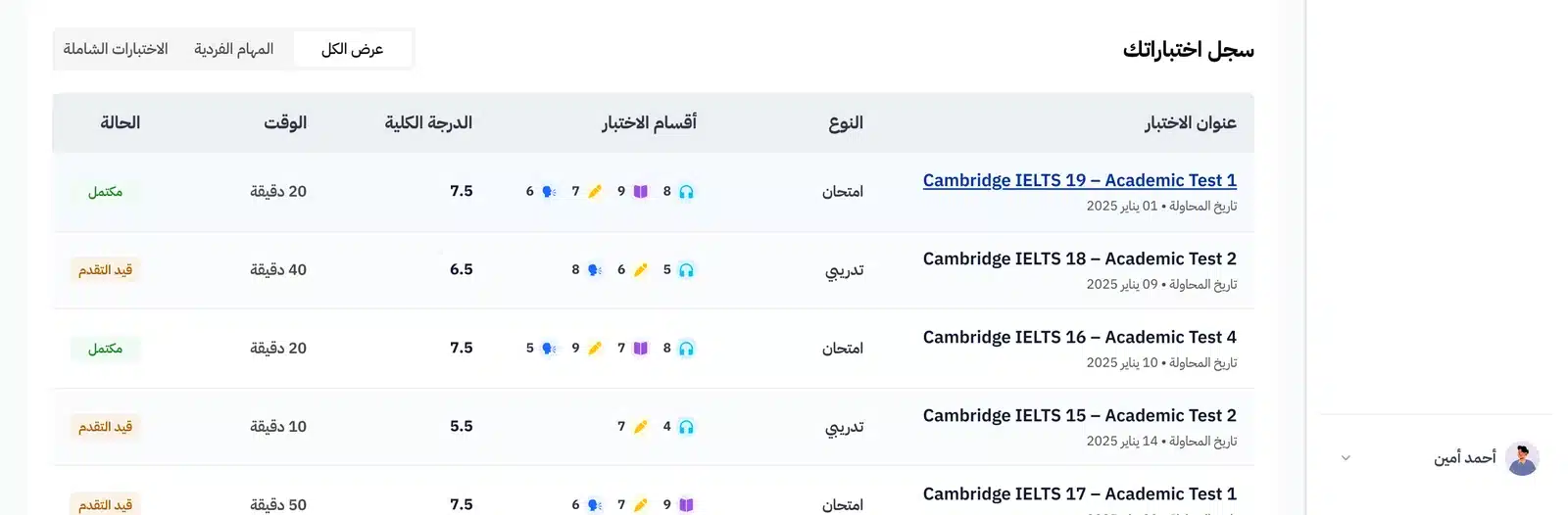
This is where performance reports and tracking help.
You can see:
- Your score trend.
- How individual skills are developing.
- Your strong and weak areas.
- Recurring error patterns.
- Progress towards your target band.
- What to focus on next.
This changes the question from:
What did I score today?
To:
Is my overall performance improving?


1 / 3
Once you see the value of fresh tests, the next question is: what does GoIELTS add after the free trial, and is a subscription right for you?
Make your next mock test another meaningful checkpoint in your journey.
5
Stage 5 You have tried GoIELTS and are considering a subscription
▾
Tried GoIELTS and wondering whether a subscription is worth it? Look beyond the number of available tests.
Compare what happens after each test: can you understand your mistakes, identify what to improve, use fresh questions and track your progress?
Looking for IELTS mock tests? Compare more than just test quantity
Searching for an IELTS mock test will bring up plenty of options.
Now that you understand the preparation cycle, your comparison criteria should change.
Don’t just ask:
“Do they have a Mock Test?”
Not even:
“How many tests do they have?”
The most important question:
What happens after I click Submit?
After you submit a test, ask these six questions:
1. Understanding: Do you know why you made a mistake?
2. Improvement: Do you know what to practice after the result?
3. Reassessment: Can you test on new content after practice?
4. Progress tracking: Does the platform save your results so you can track trends?
5. Practice Mode and Exam Mode: Can you learn with flexibility and also test under more realistic exam conditions?
6. Readiness: Can the platform help you judge when you are ready to move from improvement to test-day preparation?
Because there is a big difference between:
Test → score → done.
versus:
Test → analysis → understand mistakes → recommendations → practice → fresh test → comparison → progress → readiness.
In short: compare platforms by what happens after you submit, not only by the number of tests.
The real difference is not the test itself, but what you learn from the result and what you can do next.
Instead of just reading about it, try the experience yourself and see what happens after Submit.
GoIELTS follows one cycle: assess → understand → practise → reassess → track progress
GoIELTS is more than a place to sit a mock test and receive a score.
It is designed around the preparation cycle, with different tools for different goals.
Digital Cambridge IELTS practice tests instead of random exercises
GoIELTS offers Cambridge IELTS practice tests digitally, giving you more relevant exam-style preparation than a random collection of unrelated questions.
With a subscription, you can access more than 100 tests for practice and reassessment throughout your journey.
But the number alone is not the key benefit.
What matters is what you can do with each test and its results.
After each test, review mistakes and recommendations, practise your priorities, then try fresh questions to check progress. Over time, your test history shows whether you are moving closer to your target score.
No need to rely on paper books, manual scoring and separate spreadsheets
The traditional approach can involve:
And trying to remember how you performed two weeks earlier.
GoIELTS brings these steps together in one digital experience:
test → assessment → feedback → recommendations → practice → reports → retest.
Instead of spending time organising your scores and notes, you can focus on what matters: improving your performance.


1 / 2
Try the GoIELTS preparation cycle with your own results before deciding.
Do you have to pay before you know whether GoIELTS suits you? No.
You do not need a paid subscription to try GoIELTS and see its feedback and recommendations based on your own performance.
The free trial is more than a static demo. You can use a test in both core modes.
In the free trial you get:
- one Cambridge test rather than a library of different tests.
- Two full-test attempts using the same test in Exam Mode.You can experience timed test conditions, review your performance and try again after applying the feedback.
- Three attempts per individual skill using the same test in Practice Mode.This lets you focus on a skill without completing the full test every time.
- For Listening and Reading you can review right and wrong answers. For Writing and Speaking you receive criteria-based feedback, including key mistakes and prioritised improvement recommendations.
Important: Your available attempts let you practise again using the same test. They do not mean you receive additional different tests. New test versions for reassessment are part of the paid library.
Your free results also show a preview of more detailed insights based on your performance:
You can see your main mistakes and first improvement recommendations for free, while explanations of the remaining mistakes and the full set of personalised recommendations stay locked until you subscribe.
That means you do not have to imagine what a subscription offers.
You can experience some of the value using your own results.
See how the assessment helps you before deciding whether to pay.
Finished your first assessment? See what a subscription adds
After your first assessment, you will understand three things that were less clear before:
- You know your current score.
- You know the gap between your score and your target band.
- You know your most important priorities for improvement.
That raises a new question: what should I do next?
A subscription helps you continue with three important parts of the journey:
First: fresh tests to measure progress again
A subscription unlocks a library of more than 100 tests, but the value is not just the number. It is being able to return after practice to fresh questions and see whether your improvement carries over.
Second: a full explanation of your mistakes
Your free results explain the main mistakes. A subscription unlocks detailed explanations of every mistake identified in your assessment so you can understand recurring patterns, their causes and how to change them.
That helps you see the whole picture rather than fixing only part of the problem.
Third: complete improvement recommendations
The free trial shows you the most important priorities. A subscription unlocks the full set of improvement recommendations tailored to your performance so you can keep working on the remaining opportunities.
A subscription does not just mean more content; it provides fresh tests for reassessment + deeper insight into your mistakes + complete improvement recommendations.
Then repeat this cycle with new mock tests to build a clearer picture of your progress.
Free trial vs paid subscription at a glance
The free trial helps you answer:
- Where am I?
- What are my main problems?
- What is the most important thing to start fixing?
- And what does a GoIELTS journey look like?
One Cambridge test · Two full-test attempts in Exam Mode + three attempts per individual skill in Practice Mode · Explanations of key errors and prioritised recommendations.
A subscription lets you go further:
- What other mistakes am I making?
- Which recommendations will help me improve them?
- Do my improvements carry over to new questions?
- Am I improving consistently across different tests?
- Am I confident enough to consider test day?
Access to more than 100 tests · Full explanations of identified errors · Complete recommendations tailored to your performance.


If you would like to continue after the free trial, compare the available plans and their features before subscribing.
Your 72-hour welcome offer starts after your first assessment
After your first assessment, you know your current score, target and initial improvement priorities. Which plan best meets your needs?

Offer duration: 72 hours after your first assessment
See the suggested plan and any available discount based on your current score and distance from your target band.
Illustrative preview, not a live countdown. A subscription is required to unlock paid features.
After your first assessment, you receive a 72-hour welcome offer.
The discount percentage is not the same for every learner.
Someone close to their target may need a different plan from someone with a larger gap.
GoIELTS suggests a plan based on your current performance and target score, and displays the discount associated with that plan.
The decision should not begin with:
Which plan is cheapest?
Instead, ask:
Where do I stand, and how far am I from my target?
Choose a plan that matches the preparation you still need.
Know your gap? Do not stop after the first result.
The welcome offer lasts 72 hours after your first assessment. During that time you can review the suggested plan and any discount. If you subscribe, you unlock the included analysis, recommendations and additional tests. A discount alone does not unlock paid features without a subscription.
As test day approaches, the question changes from How do I improve? to Can I reproduce my target score under realistic conditions?
Understand your gap and the value of feedback? Review your suggested plan before the welcome offer ends.
6
Stage 6 Your IELTS test is approaching and you want to check your readiness
▾
Is your IELTS test coming up? Reaching your target score once is useful, but can you repeat it under similar test conditions?
Now the focus shifts from improvement to consistent results. Use Exam Mode to practise under timed conditions, then aim to achieve your target band on several different full tests.
Exam Mode simulates test-day conditions to help assess your performance
When test day is approaching, knowing the material is not enough.
The test assesses more than knowledge. It also tests your ability to manage time, stay focused and follow exam rules under pressure.
That’s why Exam Mode is designed to simulate the timing, sequence and restrictions of the official test so you can assess your performance in realistic conditions.
Work through the test in its prescribed sequence and time limits, rather than answering everything at your own pace.
For Listening, Exam Mode limits pausing and replaying in a way that is closer to test conditions.
The goal is not to make the experience difficult for you.
The goal is to detect problems with timing, focus and pressure during practice, not on the day of the official test.
Exam Mode helps you answer a question that matters more than knowing the correct answers:
Can I maintain my performance under exam timing and pressure?
If you want to assess yourself under realistic conditions, complete a full mock test.
Is test day approaching? Your mock tests now serve another purpose
Your IELTS test is approaching, and you may have reached your target band once. Can you do the same with a different set of questions under exam conditions?
Focus on consistent results, not just reaching your target score once
After practising exam timing in Exam Mode, take several different full tests. Does your score remain close to your target, or vary widely between tests?
Check your performance across all four skills, and do not rely on the overall band score alone if your university or scholarship provider requires a minimum for each skill.
One set of questions might suit your strengths more than another.
You may simply have had a particularly strong day.
Or the question types may align with your strongest skills.
One great result is encouraging, but repeated results across different tests offer stronger evidence of consistency.
If you have not booked the official IELTS test yet: GoIELTS recommends aiming to achieve your target Overall Band score in three different full mock tests, as well as meeting any required minimum in each skill, before deciding to book.
1/3 ← 2/3 ← 3/3
Repeating your target score across different tests is a better indicator of consistency, but it does not guarantee the same result in the official IELTS test.
If you have already booked and your test is approaching: Use Exam Mode with different tests to check your performance under time pressure. Focus your final practice on remaining mistakes and weaker skills; you do not need to reconsider your booking decision.
This is a GoIELTS recommendation to help assess consistency; it is not an official IELTS rule or booking requirement.
Close to your target? Complete a different full mock test and build consistent results step by step.
Know where you stand? Find out what you should do next. Go to your next step.
You know your route. Take the first step with confidence
You do not need to guess your level or waste time on random exercises. Start with a free assessment, see your score and weak areas, and choose a clear next step toward your target.
Frequently asked questions about IELTS mock tests and GoIELTS
Do I need a mock test if I am just starting IELTS preparation?▾
Yes. The first mock test is not about proving readiness. It establishes a baseline and helps identify the gap to your target, so you can focus your practice on what matters.
Is one mock test enough?▾
One test is enough for an initial assessment, but not enough to measure improvement across your journey. After practising, use a different test to see whether your learning transfers to unfamiliar questions.
Is repeating the same mock test useful?▾
Yes. Repeating the same test helps you learn from feedback. However, a higher score on familiar questions alone is not enough to prove your overall level has improved.
What is the difference between Practice Mode and Exam Mode?▾
Practice Mode Practice Mode supports flexible learning, focused work on one skill and repeat attempts.
Exam Mode Exam Mode measures performance under realistic timing, sequence and restrictions.
What do I get in the GoIELTS free trial?▾
You can use one Cambridge test during the free trial: two full-test attempts in Exam Mode and three attempts for each individual skill in Practice Mode, all using the same test rather than different tests.
After the assessment, review your Listening and Reading answers and criteria-based Writing and Speaking feedback. You can see your main mistakes and prioritised recommendations; additional fresh tests require a subscription.
Which parts of my results are locked in the free trial?▾
The free assessment shows your main mistakes and initial recommendations. The explanations of the remaining errors and the full personalised guidance stay locked until you subscribe.
What do I get with a subscription?▾
A subscription unlocks full error analysis and recommendations, plus a library of over 100 tests for fresh practice and reassessment.
Why use multiple tests instead of trying to complete as many as possible?▾
You do not need to complete them all.
A large library lets you try different questions over the course of preparation instead of repeating the same test.
Each new full test can offer another meaningful checkpoint.
When does the new-user offer begin?▾
The welcome offer begins after your first assessment, once you have seen your score, gap and the initial value of the platform.
The offer remains available for 72 hours.
Does everyone receive the same discount?▾
No. The percentage depends on the plan suggested for you.
The suggested plan is based on the gap between your current performance and your target band.
How do I know when I am ready to book the official IELTS test?▾
Reaching your target once is a positive sign, but it matters whether you can repeat that result. GoIELTS therefore recommends achieving your target Overall Band in three different full mock tests, while also meeting any skill-specific minimum required by your institution, before deciding to book.
This recommendation helps you assess consistency. It is not an official IELTS rule.
Achieving your target band across three different mock tests is a GoIELTS recommendation, not an official IELTS rule or a guarantee of the same result on test day.