
Article Summary
● A mini IELTS mock test is useful when you want a quick initial snapshot, while a full mock is better when you need to assess all four skills under more realistic timing.
● Skill-focused practice is the best option when you already know the specific skill or question type that needs work. You do not need to retake a full mock after every mistake.
● A mini-mock result cannot be converted directly into an official IELTS Band Score. It measures only the questions and skills included in that particular practice test.
● Use Practice Mode to learn from mistakes and develop technique, then use Exam Mode to check whether you can apply what you learned under timed conditions.
● The most effective preparation cycle is: test to identify the problem → practise the cause → measure again with new material.
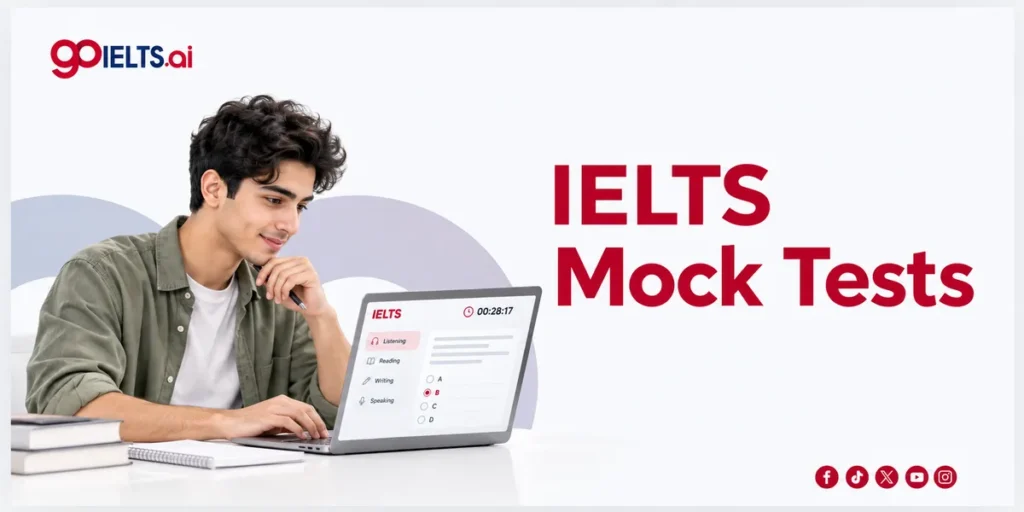
Should you start with a full IELTS mock test that takes a substantial amount of time, or choose a mini mock to get a quick idea of where you stand? The answer depends on what you want the test to tell you: are you looking for an initial snapshot of your performance, do you want to assess all four skills, or do you already know your weak area and need targeted practice?
The short answer: Choose a mini mock when you want a quick initial check. Take a full mock when you need to practise all four skills under realistic timing. Use skill-focused practice when you already know which skill or question type needs work. In many cases, the best approach is to combine all three rather than treat them as competing options.
Full vs Mini IELTS Mock Test: What’s the Difference?
A mock test (Mock Test) is a preparation and assessment tool; it is not the official IELTS test and does not produce an official Test Report Form. A “mini mock” (Mini Mock) is not a standardized official IELTS format, so its length and skill coverage can vary between platforms.
On GoIELTS, you can think of your practice in three formats:
| Comparison | Mini mock | Full mock | Skill-focused practice |
|---|---|---|---|
| What does it include? | 20 Reading and Listening questions in the free GoIELTS mini mock | All four skills: Listening, Reading, Writing, and Speaking | One skill, one question type, or a focused part of a skill |
| Time | 15 minutes on the GoIELTS mini mock | Exam-style timing across the four skills; the official IELTS test takes about 2 hours and 45 minutes in total | Depends on the skill and activity |
| Main purpose | Get a quick initial snapshot of the two skills tested | Assess broader performance and practise time management across the full test | Understand and correct a specific weakness |
| What does it not tell you by itself? | It does not assess Writing or Speaking and cannot estimate your complete IELTS performance | It cannot guarantee the same result in the official test | It may not show how you perform across a full exam session |
The main difference is not simply the length of the test, but the amount and type of information the result can give you. A short quiz can alert you to a possible weakness, but it does not automatically explain the cause. Likewise, a full single-skill test, such as a 60-minute Reading test, still measures only that skill and is not a complete four-skill IELTS mock.
When Should You Start With a Mini IELTS Mock Test?
If you are just starting your preparation or are not yet familiar with IELTS question types, a short test can give you a practical starting point without requiring a long session.
The free GoIELTS mini IELTS mock test includes 20 Reading and Listening questions to complete in 15 minutes, with no sign-up required. It can show how you handled the questions presented and which of the two tested skills may need more attention in that attempt.
Interpret the result within those limits. Missing several Reading questions does not prove that Reading is your weakest of the four IELTS skills because the mini mock does not test Writing or Speaking. Likewise, a strong mini-mock result does not prove that you are ready for a full 60-minute Reading section or a longer exam that requires sustained concentration.
Example: A learner who is starting IELTS preparation and has only 20 minutes available today could take the mini mock to become familiar with the question experience, then note whether the main challenge was understanding the text or finding the answer within the time limit. When they need a broader picture across all four skills, they can move on to a full mock.
If you are unsure how best to assess your starting level, you may also use an IELTS level assessment.
When Do You Need a Full IELTS Mock Test?
Choose a full mock when the question you want to answer is: “How will I perform across all four IELTS skills under conditions that are closer to the real exam?” A full mock is not simply a way to answer more questions.
The official IELTS test includes Listening (about 30 minutes), Reading (60 minutes), Writing (60 minutes), and Speaking (11–14 minutes), for a total test time of roughly 2 hours and 45 minutes. Listening, Reading, and Writing are taken in one session without the usual breaks between them, while Speaking may be scheduled separately. Short practice sessions alone cannot show how well you manage your concentration and time across the complete test.
A full mock is especially useful when:
- You can complete each skill separately but do not yet know how you will cope with a longer test session.
- You are approaching the end of a preparation phase and want to assess all four skills rather than rely on your impression of one area.
- You suspect that time management, rather than question comprehension alone, is reducing your performance.
- You want a new benchmark after a period of targeted practice.
On the GoIELTS platform , you can practise all four skills in a full mock using Exam Mode to simulate exam-style conditions. Set aside enough uninterrupted time, complete the test without searching for answers or pausing to study, and review your performance only after the mock is finished.
Make sure you use the correct IELTS test type: Listening and Speaking follow the same format in IELTS Academic and General Training, while Reading and Writing differ. Use practice materials that match your test type; an Academic Reading result should not automatically be treated as a General Training Reading result.
If your main difficulty is finishing on time, focus on IELTS time-management strategies after identifying the section where you lost time. The answer is not always to rush every question equally.
What if You Only Need to Practise One Skill?
This is where skill-focused practice becomes useful. Instead of retaking a complete mock after every mistake, focus on the skill or question type highlighted by your result and use Practice Mode to work through questions flexibly and review your answers. Then switch to Exam Mode when you want to check whether you can apply what you learned under timed conditions.
Consider these examples:
Reading: You keep making mistakes on True / False / Not Given. Before retaking a complete Reading test, practise a new set of the same question type. Remember: False means the passage contradicts the statement, while Not Given means the passage neither confirms nor contradicts it. Review the evidence in the passage for every answer, not just whether the letter or option was correct.
Listening: You miss an answer when you hear the recording once, but find it easily when you replay the audio. Use replay during learning to understand why you missed the information, then test yourself with a new recording played only once; in the official IELTS Listening test, recordings are played once.
Writing: You struggle to develop ideas in Writing Task 2. Write a response to a new task and check whether you answered the question fully and supported your main ideas with relevant explanations and examples. Do not reduce Writing performance to word count or advanced vocabulary alone; Task Response is one of several assessment criteria used for Writing Task 2.
Skill-focused practice is not necessarily the same thing as a mini mock. It may involve one question, one question type, or a full test of a single skill. Start by deciding what you need: Am I learning how to solve the task, or am I testing whether I can do it independently?
How to Choose Between a Mini Mock, Full Mock, and Skill-Focused Practice
Choose based on your current situation rather than assuming that a longer test is always better:
| Your current situation | Best next step | What to do afterwards |
|---|---|---|
| You have not tried IELTS questions before | Take a mini mock to become familiar with the experience | Move to a broader assessment when you want to evaluate all four skills |
| You know you struggle with a specific question type | Use targeted practice with new questions of that type | Test the skill under timed conditions after reviewing your mistakes |
| You can complete sections separately, but run out of time in simulations | Take a full mock or a full timed skill test, depending on the scope of the problem | Identify exactly where the time was lost |
| You have completed a preparation phase | Take a full mock | Compare the mistakes and error patterns with a previous attempt |
| Your test date is close and you have not completed a full simulation | Take a full mock if you still have enough time to complete and review it properly | Focus on the most important weakness instead of filling the final days with back-to-back mock tests |
This is a suggested preparation framework, not an official IELTS rule. If you already know your weak area, there is no need to take the mini mock first. And if you do not have enough time to complete and review a full mock properly, schedule a suitable session instead of splitting the “full mock” into separate pieces and treating it as one continuous simulation.
Does a Mini Mock Result Predict Your IELTS Band Score?
A mini-mock result cannot be treated as a complete IELTS score or converted directly into an official Band Score. The free GoIELTS mini mock measures Reading and Listening only and contains 20 questions in total. By comparison, the official IELTS Listening and Reading sections each contain 40 questions, and each skill has its own scoring conversion.
For example, getting 15 correct answers out of 20 on a short quiz does not justify assuming that you would get 30 out of 40 on the official test. Topics, question types, timing, and difficulty can vary, and Reading score conversions also differ between Academic and General Training.
Writing and Speaking are assessed using multiple criteria, including coherence, vocabulary, and grammar, along with skill-specific criteria. Any automated practice score or feedback is therefore an estimate and is not an official IELTS result or a judgment from a certified IELTS examiner.
Why Can Your Mini-Mock Score Be Higher Than Your Full-Mock Score?
There is no single automatic explanation. Before judging your level, ask:
- Did both tests measure the same skills and question types?
- Had you already seen some questions in the mini mock but faced new material in the full mock?
- Were most mistakes at the end of the section, suggesting a timing issue, or spread throughout the test?
- Did you listen to each recording once in both attempts, or did you use replay during practice?
Example: A learner answers most questions correctly in a short Reading quiz, then leaves seven questions blank in a full Reading test. That difference does not by itself prove weak reading comprehension. The main problem may be time management, so the learner should review where the unanswered questions appeared and where time was lost before choosing the next training step.
Even a full mock cannot guarantee the score you will receive in the official IELTS test. Use it as a preparation benchmark, not as a promise of a specific Band Score.
How to Combine Mini and Full Mock Tests During Preparation
The goal is not to complete as many tests as possible. Build a clear cycle instead: test to identify the problem → practise the cause → measure again with new material.
You can apply this cycle as follows:
- Start with the type of assessment that matches your goal. A mini mock works well for an initial snapshot; a full mock is more useful when you need a broader view of all four skills.
- Analyze your mistakes instead of looking only at the score. Record the skill, question type, possible reason for the mistake, and whether you ran out of time before reaching the question.
- Use targeted practice for the clearest weakness. For example, if you repeatedly miss Not Given, do not spend the whole following week practising unrelated Writing tasks.
- Measure improvement with new material. Repeating an old question can help you understand the mistake, but getting it right after seeing the answer is not enough evidence that you can handle a new question of the same type.
- Return to a full mock when you need another broad assessment. Compare results while accounting for differences in test version, timing, and testing conditions.
Example of a flexible four-week cycle: Week 1: take an initial assessment or full mock depending on your starting point. Week 2: complete targeted practice. Week 3: reassess the weak skill or take another full mock when appropriate. Week 4: review remaining mistakes and complete a final simulation if it fits your schedule. This is a flexible framework, not a fixed recipe, and not every learner needs a full mock every week.
If you want to fit this work into a broader daily routine, you can also use anIELTS one-month study plan and adjust it to your current level and test date.
Frequently Asked Questions
No. The GoIELTS mini mock gives you a quick Reading and Listening check, while a full mock covers all four skills and lets you practise a much longer, more exam-like experience. Choose the format based on the information you need at that stage of your preparation.
Not necessarily. If you already know your main weakness, targeted skill practice may be more useful. If you want a broader assessment of your current readiness across all four skills, a full mock may be the better starting point.
There is no single official number that suits every learner. Take enough mocks to identify patterns, review each attempt properly, practise the weaknesses you find, and then measure again. One carefully reviewed mock can be more useful than several back-to-back attempts with no analysis.
Practice Mode is useful for learning techniques, reviewing mistakes, and working on specific skills. It does not fully test your ability to manage exam timing or handle Listening recordings under one-play conditions. Use Exam Mode later to check your performance under more realistic constraints.
About the Content Team at GoIELTS
GoIELTS creates specialized content for IELTS with contributions from writers experienced in education and test preparation.
We follow clear editorial standards for accuracy and quality — read our Editorial Policy


Related Posts
IELTS Listening Vocabulary: 150+ Common Words, Spelling & Tips
November 7, 2025

Saudi Cultural Scholarship Program 2026: Requirements, Majors & Application
October 11, 2025
IELTS Writing Task 1: Templates, Examples & Tips 2026
October 11, 2025

IELTS Speaking Questions: Parts 1, 2 & 3 + Answers 2026
November 11, 2025
How to Prepare for IELTS in 2026: 7 Steps to Success
March 9, 2026

How to Understand Your IELTS Mock Test Results and Improve Your Score
September 16, 2026
GoIELTS is an independent training platform specializing in IELTS preparation and is not affiliated with any official organization that owns or administers the IELTS test. The content is provided for educational and informational purposes only and reflects our team’s experience and the latest information available at the time of publication. Information may change without notice. Any use of the information is at the reader’s own responsibility, and results vary depending on each learner’s level and effort. For the latest official requirements, we recommend checking the official IELTS website and the relevant scholarship or sponsoring authority. — Full Disclaimer