
Article Summary
● IELTS Writing Task 1 requires at least 150 words and is best completed in about 20 minutes: describe visual information in Academic or write a letter in General Training.
● Task 1 is assessed on four criteria: Task Achievement, Coherence and Cohesion, Lexical Resource, and Grammatical Range and Accuracy.
● This guide includes practical structures for charts, tables, maps, processes, and General Training letters.
● It includes examples from Cambridge IELTS materials with sample responses and examiner comments.
● GoIELTS provides Task 1 practice with automated feedback to help you identify weaknesses and improve your writing.
IELTS Writing Task 1 is the first part of the IELTS Writing test. You need to write at least 150 words, and you should spend about 20 minutes on it.
In IELTS Academic, you write a report describing visual information such as charts, graphs, tables, maps, or a process. In IELTS General Training, you write a letter in an appropriate formal, semi-formal, or personal style.
This guide covers everything you need for IELTS Writing Task 1, including the task requirements, practical strategies, ready-to-use structures, and examples from Cambridge IELTS books with sample responses and examiner comments.
What is IELTS Writing Task 1?
IELTS Writing Task 1 assesses how clearly and accurately you can communicate information in writing. The task changes depending on whether you take IELTS Academic or IELTS General Training.
From mid-2026, IELTS is moving away from the traditional full paper-based test, with exact timelines varying by market. In selected countries, IELTS on computer also offers a Writing on Paper option, where the Writing tasks appear on screen but you handwrite your answers. The task types, timing, and scoring remain the same.
- IELTS Academic Writing Task 1: You write a report describing visual information such as a graph, chart, table, map, or process.
- IELTS General Training Writing Task 1: You write a letter responding to an everyday situation. The tone may be formal, semi-formal, or personal depending on the audience and purpose.
IELTS Writing Task 1 & Task 2 TemplatesReview practical structures for Task 1 charts, tables, maps, processes, and Task 2 essays, with useful opening language and organization tips.
IELTS Writing Task 1 Requirements
Time for IELTS Writing Task 1
You should spend about 20 minutes on Task 1 in both IELTS Academic and IELTS General Training. The full Writing test lasts 60 minutes, and Task 2 carries twice as much weight as Task 1.
Word count for IELTS Writing Task 1
You must write at least 150 words. Writing more than 150 words is allowed, but an unnecessarily long Task 1 response can leave you with less time for Task 2.
IELTS Writing Task 1 assessment criteria
Task 1 is assessed using four criteria, each contributing equally to the task score:
- Task Achievement – How fully, accurately, and appropriately you address the task.
- Coherence and Cohesion – How clearly your ideas are organized and connected.
- Lexical Resource – The range, accuracy, and appropriateness of your vocabulary.
- Grammatical Range and Accuracy – The range and accuracy of your grammatical structures.
Why do many test takers find Task 1 difficult?
IELTS Writing Task 1 can be challenging for several reasons:
- Time pressure: You have about 20 minutes to plan, write, and check your response.
- Different task types: Academic candidates describe visual information, while General Training candidates write a letter. Each requires a different structure and register.
- Accuracy matters: You need clear vocabulary, accurate grammar, and a focused response without unnecessary detail.
See our complete IELTS Writing guide for 2026 for a broader overview of the Writing test.
IELTS Academic Writing Task 1
- In IELTS Academic Writing Task 1, you write a descriptive report based on visual information presented as a graph, chart, table, map, or process diagram.
- The main goal is to identify key features, make relevant comparisons, and present the information clearly and accurately in an academic or neutral style.
Types of IELTS Academic Writing Task 1 Questions
Academic Task 1 questions vary, but all require you to describe, summarize, or explain visual information without giving your personal opinion.
The main task types include:
1. Graphs and Charts
These include bar charts, line graphs, and pie charts. You may need to compare figures, describe trends over time, or identify differences between categories.
You may also encounter mixed charts that combine more than one visual, such as a line graph with a bar chart or a chart with a table. It is useful to practise these separately as part of your preparation.
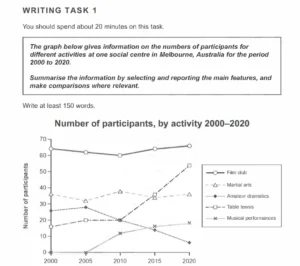
IELTS Writing Task 1 Graph Example with a Sample Answer
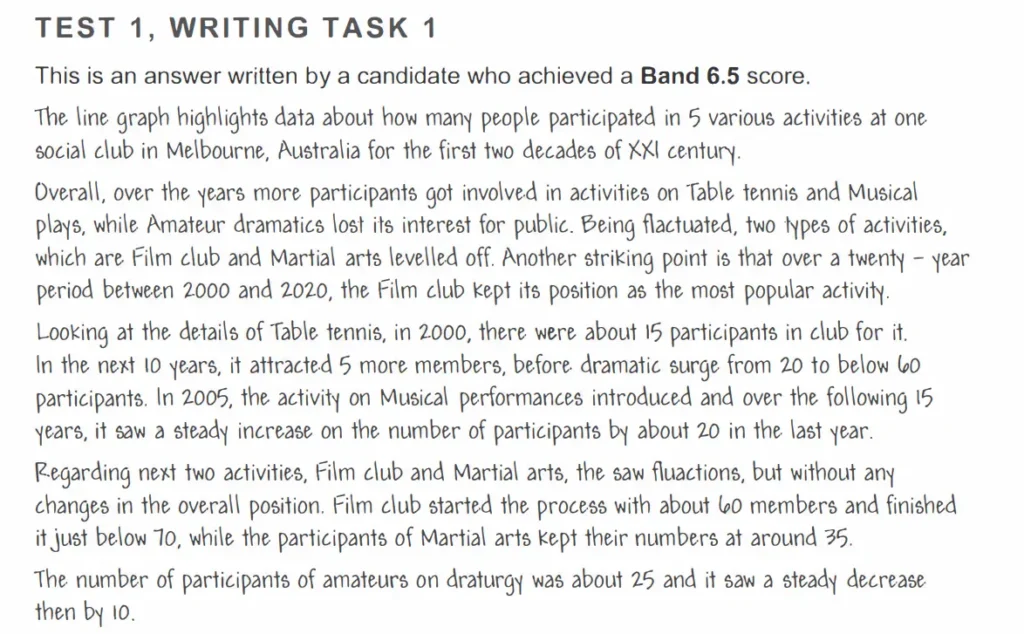
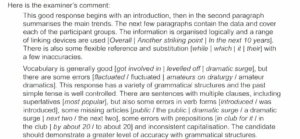
The following images show a graph from Cambridge IELTS Book 19, along with a sample response from a test taker who received Band 6.5 for Writing and the examiner’s comments.
Question
Sample student response
Examiner comments
Source: Cambridge IELTS Book 19 – Test 1
2. Tables
Tables present figures or statistical information that you need to summarize, compare, and explain by focusing on the most important features.
IELTS Writing Task 1 Table Example with a Sample Answer
The following example is a table task from Cambridge IELTS Book 10, together with a sample answer provided in the Cambridge material.
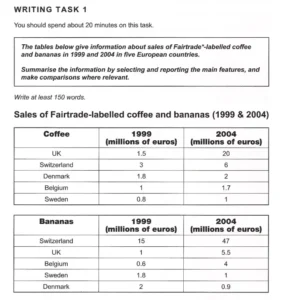
Sample answer
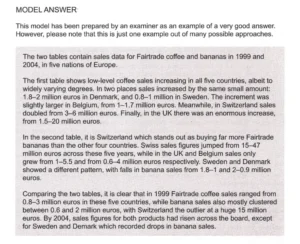
Source: Cambridge IELTS Book 10 – Test 2
3. Processes and Diagrams
You may be asked to describe the stages of a manufacturing process, a natural life cycle, or how a device or system works.
IELTS Writing Task 1 Process Example with a Sample Answer
The following images show an ethanol-production process from Cambridge IELTS Book 19, along with a sample response from a test taker who received Band 6.5 for Writing and the examiner’s comments.
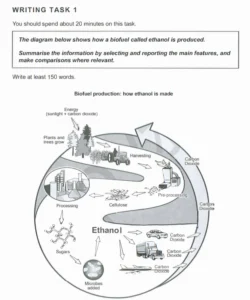
Sample student response

Examiner comments

Source: Cambridge IELTS Book 19 – Test 3
4. Maps
Map tasks usually ask you to describe how a place or area changed over time, highlighting the most significant developments and comparisons.
IELTS Writing Task 1 Map Example with a Sample Answer
The following images show the same location at two different points in time from Cambridge IELTS Book 19, along with a sample response from a test taker who received Band 6.5 for Writing and the examiner’s comments.
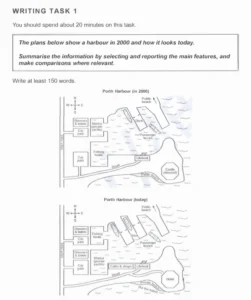
Sample student response

Examiner comments

Source: Cambridge IELTS Book 19 – Test 2
Also read: key techniques for improving your IELTS Writing performance.
Practical Tips for IELTS Academic Writing Task 1
To improve your score in Academic Writing Task 1, use the following approach:
- Read the task carefully: Spend around 2–4 minutes understanding the visual, identifying the task type, and deciding which features are most important.
- Start with a simple introduction: Paraphrase the task in one or two sentences instead of copying the prompt word for word.
- Write a clear overview: Before giving detailed figures, summarize the most important trends or features. For example:
The number of students increased significantly between 2000 and 2010.
- Organize your response: A common structure is introduction, overview, first detail paragraph, and second detail paragraph.
- Use an academic or neutral style: Avoid personal opinions such as “I think” or “in my opinion.” Focus on objective description.
- Use varied vocabulary: Use accurate trend language such as rise, drop, and fluctuate, as well as linking language such as however and while.
- Control your time: Aim to complete Task 1 in about 20 minutes so you have enough time for Task 2.
- Check your work: Use the final minute to catch simple grammar, spelling, or data-reporting mistakes.
Also read our complete IELTS Writing Task 2 guide once the English version is available.
IELTS Academic Writing Task 1 Templates
Use these structures as flexible guides rather than memorized answers. Adapt the language to the visual information in the question.
1. Introduction
Start by paraphrasing the task using your own words.
Example:
The graph illustrates the number of international students studying in Canada between 2000 and 2020.
2. Overview
Write one or two sentences summarizing the main trends or features without unnecessary numerical detail.
Useful overview phrases:
- Overall, it is clear that…
- In general, we can see that…
- The most noticeable trend is that…
3. Details – Paragraph 1
Select two or three important features and support them with relevant figures or comparisons.
Useful ways to begin:
- At the beginning of the period…
- By contrast…
- It can be seen that…
4. Details – Paragraph 2
Add further details, comparisons, or changes over time.
Useful transitions:
- In terms of…
- Similarly…
- On the other hand…
- While X increased, Y decreased…
5. Conclusion (Optional)
A separate conclusion is not required in Academic Task 1 because the overview already summarizes the main features. If you choose to add a final sentence, keep it brief and avoid introducing new information.
Example:
In conclusion, the data highlights significant growth in…
Explore our IELTS Writing templates for Task 1 and Task 2.
Common IELTS Academic Writing Task 1 Mistakes to Avoid
Watch out for these common mistakes:
- Copying the task instead of paraphrasing it: Your introduction should restate the task in your own words.
- Missing the overview: A clear overview is important for Task Achievement.
- Overdescribing the data: Do not report every small figure. Focus on the main features and meaningful comparisons.
- Giving personal opinions: Academic Task 1 requires objective reporting, not your personal view.
- Weak organization: Group related information into clear, logically connected paragraphs.
- Limited or inaccurate vocabulary and grammar: Use a range of language accurately rather than forcing difficult words or structures.
- Writing fewer than 150 words: The official minimum is 150 words. A response that is too short may not provide enough evidence of the language features required for higher bands and can weaken Task Achievement.
Check your current level with the free IELTS mock test.
IELTS General Training Writing Task 1
- In General Training Writing Task 1, you respond to a situation by writing a letter of at least 150 words. You should spend about 20 minutes on the task.
- The task assesses whether you can communicate effectively in realistic situations using a style and tone that suit the audience and purpose.
Types of IELTS General Training Writing Task 1 Letters
The required register depends on who you are writing to and why. Common categories include:
Formal Letters
Formal letters are used when writing to an organization, company, official, or someone you do not know personally.
Common purposes include:
- Requesting information.
- Making a complaint.
- Requesting a refund or compensation.
- Applying for a job or study opportunity.
Semi-formal Letters
Semi-formal letters are used when you know the recipient but the situation still requires a respectful or professional tone, such as writing to a teacher, landlord, or manager.
Common purposes include:
- Providing information.
- Arranging or changing an appointment.
- Requesting a recommendation or reference.
Personal or Informal Letters
These are written to friends or relatives and use a warmer, more conversational tone.
Common purposes include:
- Inviting someone.
- Apologizing.
- Thanking someone.
- Sharing news or giving advice.
Practical Tips for IELTS General Training Writing Task 1
- Read the instructions carefully: Identify the relationship with the recipient and choose the correct register.
- Use an appropriate greeting: For example, use Dear Sir or Madam when you do not know the person’s name, and Dear [Name] when appropriate.
- Use a clear structure: Open with the purpose of the letter, cover each required point in separate paragraphs, and finish appropriately.
- Match the tone to the situation: Keep formal letters professional and personal letters friendly and natural.
- Cover every bullet point: Task 1 prompts typically give three points to address. Make sure none is missed.
- Use varied language: Choose suitable expressions for requests, apologies, complaints, invitations, or other purposes.
- Manage your word count and time: Write at least 150 words and aim to finish in about 20 minutes.
- Proofread quickly: Check grammar, spelling, punctuation, and whether the letter sounds natural for the intended reader.
Explore common IELTS Writing topics and examples when the English topic library is available.
IELTS General Training Writing Task 1 Letter Templates
Use the following as flexible structures. Your wording should always fit the specific situation in the task.
1. Formal Letter Template
Use this structure when writing to an organization or someone you do not know.
Greeting:
- Dear Sir or Madam,
Opening:
- I am writing to [explain/complain/request/inform] about …
Body paragraphs:
- Paragraph 1: Explain the main reason for writing.
- Paragraph 2: Give relevant details or evidence.
- Paragraph 3: State what you would like the recipient to do or clarify.
Closing sentences:
- I would appreciate your prompt response.
- Thank you for your attention to this matter.
Sign-off:
- Yours faithfully,
[Your Full Name]
2. Semi-formal Letter Template
Use this structure when you know the recipient but the situation is professional or respectful.
Greeting:
- Dear Mr./Ms. [Last Name],
Opening:
- I am writing to let you know about … / I would like to inform you that …
Body paragraphs:
- Paragraph 1: State the reason for writing, such as a request, complaint, or suggestion.
- Paragraph 2: Explain the situation and provide details.
- Paragraph 3: State what you expect or propose as a solution.
Closing sentences:
- I look forward to hearing from you soon.
- Please let me know if you need further details.
Sign-off:
- Yours sincerely,
[Your Full Name]
3. Personal Letter Template
Use this structure when writing to a friend or relative.
Greeting:
- Dear [First Name],
Opening:
- I hope this letter finds you well.
Body paragraphs:
- Paragraph 1: Introduce the reason for writing, such as an invitation, apology, congratulations, or news.
- Paragraph 2: Add relevant details in a friendly tone.
- Paragraph 3: Ask a question, extend an invitation, or mention what you hope will happen next.
Closing sentences:
- Looking forward to seeing you soon.
- Take care and write back soon.
Sign-off:
- Best wishes, / All the best, / Yours,
[Your First Name]
If you are preparing at short notice, keep your practice focused on the task types and weaknesses that cost you the most marks.
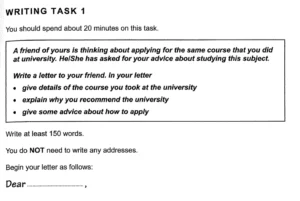
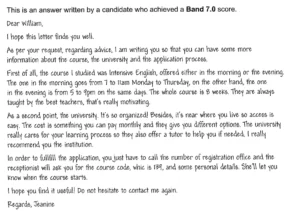
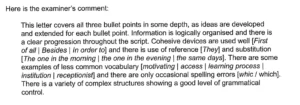
IELTS General Training Writing Task 1 Example with a Sample Answer
This example shows a General Training Writing Task 1 from Cambridge IELTS Book 15 General Training, together with a sample response from a test taker who achieved Band 7.
Question
Sample student response
Examiner comments
Common IELTS General Training Writing Task 1 Mistakes to Avoid
Avoid these common mistakes:
- Using the wrong tone: Mixing formal and informal language can make your response inappropriate for the situation.
- Missing a required bullet point: If the prompt asks you to cover three points, address all three clearly.
- Using an unsuitable greeting or sign-off: For example, Hi is usually too casual for a formal letter, while Yours faithfully is not suitable for a personal letter.
- Poor organization: Writing one long block of text makes the letter harder to follow and can weaken Coherence and Cohesion.
- Adding irrelevant detail: Long explanations outside the purpose of the letter waste time and reduce focus.
- Repeated grammar and spelling errors: Frequent errors can reduce your Grammatical Range and Accuracy score.
- Writing fewer than 150 words: The minimum is 150 words. If your answer is too short, there may not be enough evidence of the language features needed for higher bands, and Task Achievement may be affected.
Build a stronger range of language with our IELTS Writing Vocabulary guide with 500+ words and linking phrases.
How GoIELTS Can Help You Improve IELTS Writing Task 1
GoIELTS is an independent IELTS preparation platform designed to help you practise Writing Task 1 for both IELTS Academic and IELTS General Training.
1. A realistic IELTS Writing practice experience
GoIELTS provides a practice environment designed to resemble key parts of the IELTS Writing experience, including timing, a word counter, and realistic task difficulty. Practising under timed conditions can make test day feel more familiar.
2. Practice with a wide range of Writing tasks
You can practise with more than 50 Writing mock tasks based on Cambridge IELTS materials available on the platform, helping you become familiar with different Task 1 formats in both Academic and General Training.
3. Instant automated writing evaluation
The platform provides automated feedback aligned with the public IELTS Writing assessment criteria, including grammar, vocabulary, coherence, and task coverage. This helps you identify strengths and areas that need more work. It is a preparation tool and does not replace an official IELTS examiner or official IELTS result.
4. Actionable feedback for improvement
You receive practical feedback on organization, vocabulary, grammar, and common mistakes so you can revise your responses and build a more consistent writing approach.
5. An estimated band score before test day
GoIELTS can provide an estimated band score to help you gauge your readiness and decide whether you need more practice. Any score shown by the platform is a preparation estimate, not an official IELTS score.
Conclusion
Success in IELTS Writing Task 1 comes from more than knowing the theory. You need regular practice, a clear understanding of the task requirements, and a structure that fits the question type.
Focus on accurate grammar, logical organization, appropriate vocabulary, and the key features of the task. With consistent practice, you can make measurable progress and increase your chances of achieving a higher Writing band score.
Practice platforms such as GoIELTS can help you work under realistic time limits, receive automated feedback, and review weaknesses before test day. Use that feedback as part of your preparation rather than as a substitute for the official IELTS assessment.
Explore the GoIELTS features and review the GoIELTS plans to choose the option that fits your preparation needs.
Frequently Asked Questions
IELTS Writing Task 1 is the first task in the IELTS Writing test. In IELTS Academic, you describe, summarize, or explain visual information such as a graph, chart, table, map, or process. In IELTS General Training, you write a letter in response to an everyday situation.
- IELTS Academic: common task types include graphs and charts, tables, process or diagram tasks, and maps. Some questions combine more than one visual.
- IELTS General Training: you write a letter, and the appropriate register may be formal, semi-formal, or personal depending on the audience and purpose.
Common data visuals include bar charts, line graphs, pie charts, and tables. You may also receive a mixed task that combines two visuals, such as a chart and a table.
Task 1 is assessed using four equally weighted criteria:
- Task Achievement
- Coherence and Cohesion
- Lexical Resource
- Grammatical Range and Accuracy
Task 2 contributes twice as much as Task 1 to the overall Writing band score.
To work toward Band 7 or higher, address every part of the task, organize your response logically, use a clear overview in Academic Task 1 or an appropriate purpose and tone in General Training, and demonstrate a good range of accurate vocabulary and grammar. Write at least 150 words and manage your time carefully.
For Academic Task 1, a common four-paragraph structure is: introduction, overview, first detail paragraph, and second detail paragraph. For General Training Task 1, use an appropriate greeting, state the purpose clearly, cover all required bullet points in organized paragraphs, and finish with a suitable closing and sign-off.
The official minimum is 150 words. If your response is too short, there may not be enough evidence of the language features needed for higher bands, and Task Achievement may be affected. You are not penalized for writing more than 150 words, but writing too much can reduce the time available for Task 2.
About the Content Team at GoIELTS
GoIELTS creates specialized content for IELTS with contributions from writers experienced in education and test preparation.
We follow clear editorial standards for accuracy and quality — read our Editorial Policy


Related Posts
IELTS Writing Vocabulary | 500+ Words & Linking Phrases
May 16, 2026
IELTS Vocabulary: Common Words for All 4 Skills 2026
June 6, 2026
IELTS Academic Test Samples PDF
December 26, 2025

Best Universities in the USA for Saudi Scholarship Students 2026
January 19, 2026
IELTS Reading Test Guide: Question Types, Scores & Tips 2026
August 31, 2025
IELTS Resources Hub 2026: Best Websites, Books & Practice Tools
November 4, 2025
GoIELTS is an independent training platform specializing in IELTS preparation and is not affiliated with any official organization that owns or administers the IELTS test. The content is provided for educational and informational purposes only and reflects our team’s experience and the latest information available at the time of publication. Information may change without notice. Any use of the information is at the reader’s own responsibility, and results vary depending on each learner’s level and effort. For the latest official requirements, we recommend checking the official IELTS website and the relevant scholarship or sponsoring authority. — Full Disclaimer