
Article Summary
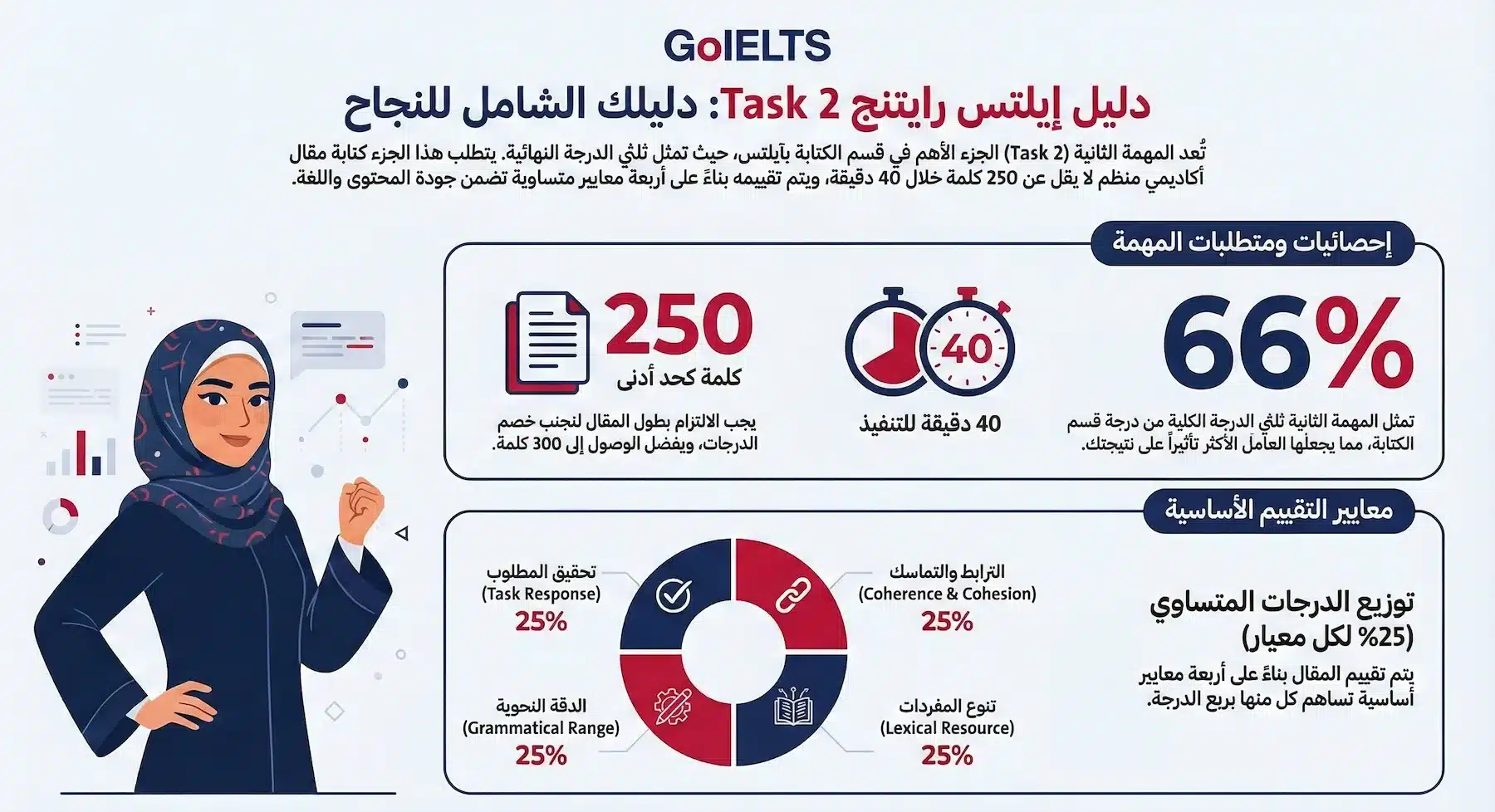
● IELTS Writing Task 2 contributes twice as much as Task 1 to the overall Writing score and requires at least 250 words. Around 40 minutes is usually recommended.
● Your essay is assessed on four equally weighted criteria: Task Response, Coherence and Cohesion, Lexical Resource, and Grammatical Range and Accuracy.
● Common training categories include opinion, discussion, problem–solution, causes/effects, advantages/disadvantages, and two-part questions. Always analyze the exact prompt before choosing your structure.
● Strong Task 2 performance depends on answering every part of the question, planning before writing, organizing ideas clearly, and supporting them with relevant explanation and examples.
● This guide includes a flexible essay structure, a complete practice example, common mistakes, and practical ways to improve your score.
The IELTS Writing test can feel challenging for many test takers, especially IELTS Writing Task 2. In this task, you write a well-organized essay that responds directly to the opinion, argument, or problem in the prompt, while developing your ideas with relevant reasons and examples.
Strong performance in Task 2 depends on more than language alone. You need to understand every part of the question, take a clear position when required, and organize your ideas in a structure that fits the task instead of relying on a memorized essay.
In this guide, you will learn the IELTS Writing Task 2 requirements, common question types, how to analyze the prompt, essay structure, scoring criteria, and the mistakes that can affect Task Response, Coherence and Cohesion, Lexical Resource, and Grammatical Range and Accuracy.
What is IELTS Writing Task 2?
IELTS Writing Task 2 contributes twice as much as Task 1 to your overall Writing score, so it has a greater effect on your final Writing band.
In this task, you write an essay of at least 250 words in response to an opinion, argument, or problem. You are expected to address the prompt directly, organize and develop your ideas, and use vocabulary and grammar accurately and appropriately.
You are not assessed on whether your personal opinion is “correct.” Instead, examiners assess how effectively you answer the task, develop your ideas, organize your response, and control your language.
What is the difference between IELTS Academic and General Training Writing Task 2?
Writing Task 2 follows the same basic format in IELTS Academic and IELTS General Training: in both versions, you write an essay of at least 250 words in response to an opinion, argument, or problem, and the same four assessment criteria are used.
In IELTS Academic, the style is generally academic, neutral, or semi-formal, and topics are framed for people entering undergraduate or postgraduate study. In IELTS General Training, Task 2 is also an essay, but topics tend to relate more broadly to everyday or general-interest issues.
The biggest Writing difference between Academic and General Training appears in Task 1. For Task 2, the underlying skills and scoring criteria are largely the same.
Also read our IELTS Writing Task 1 guide.
IELTS Writing Task 2 Requirements
Time for IELTS Writing Task 2
The full IELTS Writing test lasts 60 minutes for both tasks. Because Task 2 carries twice as much weight as Task 1, you should usually spend around 40 minutes on Task 2.
Word count for IELTS Writing Task 2
You must write at least 250 words. IELTS does not set an official maximum word count. During practice, you may find that roughly 260–300 words works well for your speed, but that is not an official rule. The priority is to answer every part of the prompt clearly and leave enough time to review your work.
Writing more words does not automatically lead to a higher score.
How should you write your answer?
Your Task 2 response should be written as a connected piece of writing using complete sentences and paragraphs. Do not write the essay as notes or bullet points.
IELTS Writing Task 2 Assessment Criteria
Your essay is assessed using four criteria, each contributing equally to the Task 2 score:
- Task Response: Have you answered every part of the question, presented a clear position when required, and developed your main ideas?
- Coherence and Cohesion: Do your ideas progress logically, and do your paragraphs and linking devices help the reader follow your argument?
- Lexical Resource: Do you use an appropriate range of vocabulary accurately and naturally?
- Grammatical Range and Accuracy: Do you use a variety of grammatical structures with good control of grammar and punctuation?
Note: In Task 2, the first criterion is called Task Response. In Task 1, the equivalent criterion is Task Achievement.
What is the difference between Band 6, Band 7, and Band 8 in IELTS Writing Task 2?
The difference is not simply about using harder vocabulary. Higher bands depend on how completely and precisely you answer the task, how well you develop your ideas, and how effectively you control your language.
- Band 6: You address the main parts of the task, but some ideas may be insufficiently developed. Organization and language may also show limited flexibility.
- Band 7: Your position is clear and developed. Main ideas are relevant, explained, and supported, with logical organization and a more flexible use of vocabulary and grammar.
- Band 8: Your response addresses the task more fully and precisely, with well-developed relevant ideas, easy-to-follow organization, and strong control of vocabulary and grammar.
If you are trying to move from Band 6 to Band 7, do not start by memorizing a list of “advanced” words. First ask: Did I answer every part of the prompt? Did I explain each main idea fully instead of simply mentioning it?
Why is IELTS Writing Task 2 Difficult for Some Test Takers?
Task 2 can feel more difficult than Task 1 for several reasons:
1. The required response is longer
You must write at least 250 words, which requires you to organize and develop ideas clearly under time pressure.
2. The topics vary widely
Questions may cover education, the environment, technology, health, work, or social issues. However, you do not need specialist knowledge. Your job is to understand the question, choose relevant ideas, and explain them logically with suitable examples.
3. You need to show analytical thinking
You are expected to do more than list ideas. Depending on the prompt, you may need to analyze an issue, compare views, explain causes, evaluate advantages and disadvantages, or support a position.
4. Language control matters
A strong essay needs clear sentence structure, accurate grammar, appropriate vocabulary, and logical connections between ideas. Trying to use overly complex language without control can hurt rather than help.
5. Time management is important
You have about 40 minutes for Task 2, which must cover planning, writing, and checking your response.
6. Task 2 has greater weight
Because Task 2 contributes twice as much as Task 1 to your Writing score, many test takers feel extra pressure. The best response is to build a repeatable planning and writing process through timed practice.
Common IELTS Writing Task 2 Essay Types
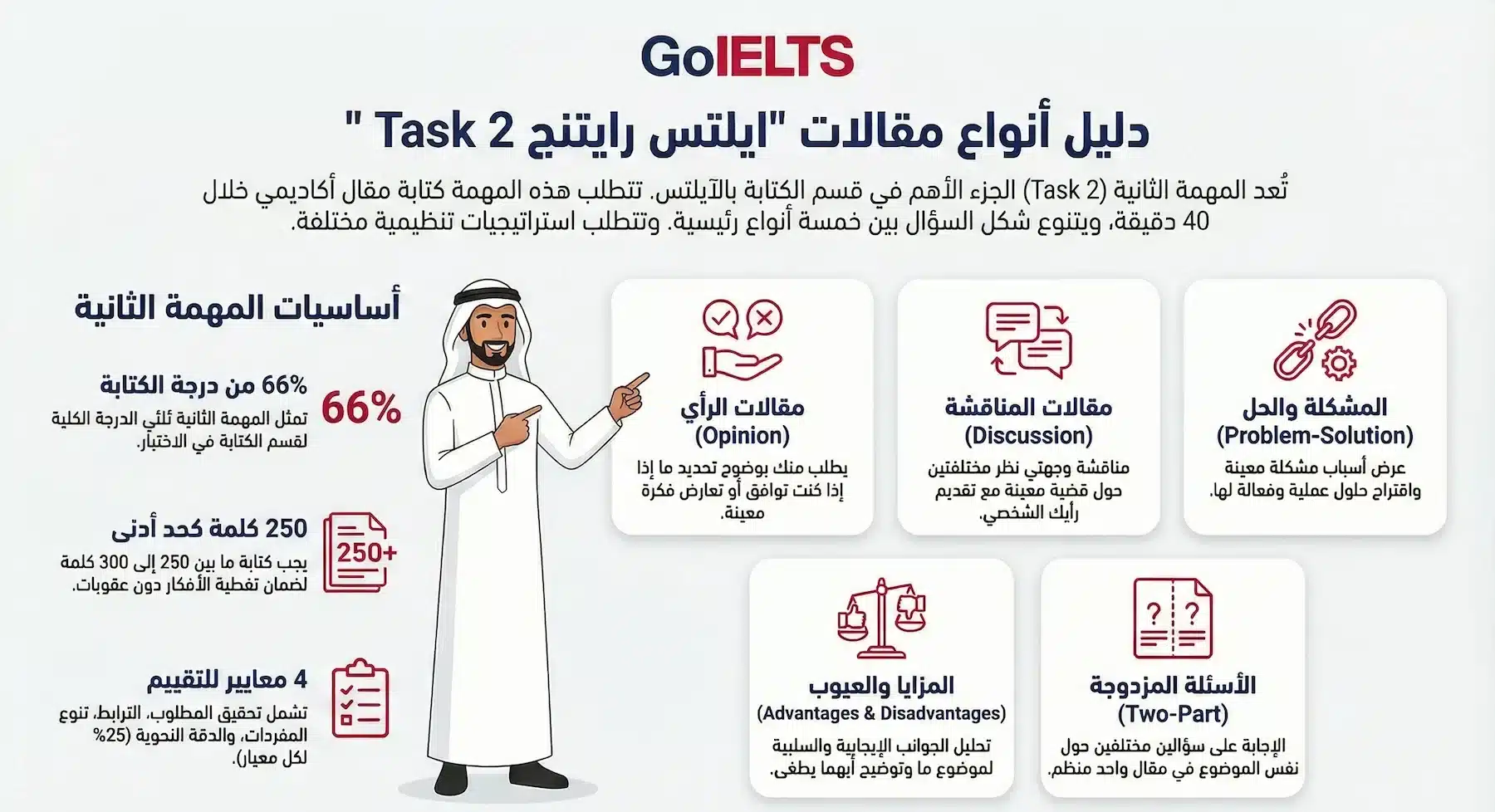
Writing Task 2 prompts can be grouped into several common training categories. This is a useful preparation framework, not an official fixed list from IELTS. In the real test, always analyze the exact wording of the prompt before choosing your structure.
1. Opinion Essays
You are asked to state how far you agree or disagree with an idea, for example: Do you agree or disagree? or To what extent do you agree or disagree?
2. Discussion Essays
You may be asked to discuss two views. If the instruction says Discuss both views and give your own opinion, you need to discuss both perspectives and clearly state your own position. If the wording is different, follow the exact task instead of adding an unnecessary opinion section.
3. Problem–Solution Essays
These questions present a problem and ask you to explain causes, suggest solutions, or both, depending on the wording.
4. Causes and Effects Essays
You may be asked to explain why a situation is happening and describe its effects or consequences.
5. Advantages and Disadvantages Essays
These questions ask you to discuss the positive and negative sides of an issue. Some prompts also ask whether the advantages outweigh the disadvantages, so read the wording carefully.
6. Two-Part Questions
These prompts contain two separate questions that both need to be answered in the same essay.
When practising, rotate between different prompt types instead of repeatedly writing the same kind of essay.
Practical IELTS Writing Task 2 Tips
Task 2 has a major impact on your Writing score, so a clear process is more useful than trying to memorize complete essays.
1. Read the question carefully and identify exactly what it asks
The most important first step is to analyze the prompt.
- Is it asking for your opinion?
- Does it ask you to discuss two views?
- Does it ask for causes, effects, problems, solutions, advantages, or disadvantages?
- Does it contain two separate questions?
A common mistake is writing a good essay that does not fully answer the actual question. That can significantly weaken Task Response.
For example, if the prompt says Discuss both views and give your own opinion, writing only your opinion is not enough. You need to address both views and then make your position clear.
2. Make a short plan before you start writing
Instead of writing immediately, spend a few minutes planning the main idea of each paragraph. Around 3–5 minutes can work well for many test takers, but adjust this during practice based on your own speed.
3. Use a clear essay structure
Your structure should match the question, but a typical Task 2 response includes:
- Introduction: paraphrase the topic and present your thesis or overall position when required.
- Body paragraphs: usually two or three paragraphs, each centered on one main idea and supported with explanation and examples.
- Conclusion: summarize the main position or argument without introducing a new idea.
4. Support your ideas with explanation and examples
You do not need specialist facts. What matters is whether your examples and explanations clearly support the argument.
A useful paragraph pattern is:
- State the main idea.
- Explain why it matters or how it works.
- Give a relevant example.
- Connect the example back to the question.
5. Use vocabulary accurately, not artificially
Use a range of vocabulary, but choose words because they fit the meaning and context, not because they sound difficult. A common word used naturally is better than an advanced word used incorrectly.
Use linking words such as however, therefore, and moreover only when they accurately express the relationship between ideas. Avoid placing a connector at the beginning of every sentence.
Vary your sentence structures only as far as you can control them accurately. A correct simple or compound sentence is better than a complex sentence full of errors.
If vocabulary is a weakness, use our IELTS Writing Vocabulary guide to practise words and collocations in context.
Useful Vocabulary and Phrases for Task 2
Giving an opinion
- In my opinion, …
- I believe that …
- From my perspective, …
Linking ideas
- Moreover, …
- However, …
- Therefore, …
Giving examples or clarification
- For instance, …
- Specifically, …
- As a result, …
6. Manage your time
Because Task 2 carries twice the weight of Task 1, it is sensible to spend about 40 minutes on it. The exact split between planning, writing, and reviewing is not an official rule.
During practice, you could experiment with around 5 minutes for planning, about 30 minutes for writing, and the remaining time for checking, then adjust based on your own pace.
7. Review your essay before submitting
Even if time is limited, use the final minutes to check:
- Did you answer every part of the prompt?
- Are your main ideas clearly developed?
- Are the paragraphs logically organized?
- Can you fix any obvious grammar, spelling, or punctuation errors?
How to Organize Your Ideas Before Writing Task 2
Planning before you start writing is one of the most useful habits for creating a clear and coherent IELTS Writing Task 2 essay. Starting immediately can lead to repetition, weak paragraphing, or missing part of the question.
Before writing, identify the task type, decide your position if one is required, and note the main ideas and examples you will use.
A Flexible IELTS Writing Task 2 Structure
Use this as a flexible framework rather than a memorized template.
Introduction
- Introduce or paraphrase the topic.
- Paraphrase the specific task where appropriate.
- State your thesis or position if the prompt requires one.
Body Paragraph 1
- Main idea 1.
- Explanation or development.
- Relevant example or evidence.
Body Paragraph 2
- Main idea 2.
- Explanation or development.
- Relevant example or evidence.
You can add a third body paragraph when the question contains more than two distinct elements and the extra paragraph improves clarity.
Conclusion
- Restate your overall position or summarize the main argument.
- Do not introduce a completely new idea.
See our IELTS Writing Task 1 & Task 2 templates for more structures.
Practical IELTS Writing Task 2 Example Using This Structure
Question
Some people believe that university education should be free for everyone. To what extent do you agree or disagree?
Sample Answer
Introduction:
There is an ongoing debate about whether university education should be free for all students. While some people argue that higher education must be accessible without cost, others believe that students should contribute financially. In my opinion, I strongly agree that university education should be free, as it can benefit both individuals and society as a whole.
Body Paragraph 1:
First of all, free university education can provide equal opportunities for students regardless of their financial background. For instance, talented students from low-income families often face difficulties in paying tuition fees, which may prevent them from continuing their studies. If education were free, these students would have the chance to reach their potential and contribute positively to society.
Body Paragraph 2:
In addition, making university education free can improve a country’s economy in the long run. Highly educated individuals are more likely to secure better jobs, pay higher taxes, and contribute to innovation. A better-educated workforce can therefore generate long-term social and economic benefits.
Body Paragraph 3 – Counterargument and response:
On the other hand, some people argue that free education would place a financial burden on governments. However, governments can control these costs through targeted funding models, taxation, or partnerships with the private sector. In the long term, the benefits of wider access to higher education may outweigh the initial cost.
Conclusion:
In conclusion, although providing free university education may require significant investment, it can improve equality of opportunity and contribute to a more skilled workforce. Governments should therefore consider policies that make higher education more accessible.
Cambridge IELTS Writing Task 2 Example with a Sample Response
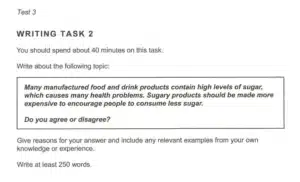
The following images show an IELTS Academic Writing Task 2 from Cambridge IELTS Academic Book 16, together with a sample student response and examiner feedback.
Question
Sample student response
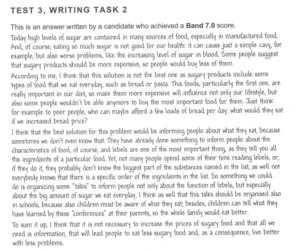
Examiner feedback
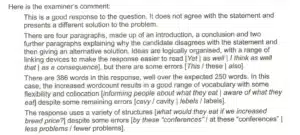
Source: Cambridge IELTS Academic Book 16 – Test 3
Common IELTS Writing Task 2 Mistakes to Avoid
These mistakes can reduce your score even when your English is generally good:
- Misunderstanding the question: Writing about a related topic is not enough if you do not answer the exact task. This directly affects Task Response.
- Weak organization: Very long paragraphs with no clear focus or progression make the essay difficult to follow. Each paragraph should have a clear central idea.
- Repeating vocabulary or using words inaccurately: Lexical Resource is about range, precision, and appropriateness, not simply using difficult vocabulary.
- Repeated grammar errors: Problems with subject–verb agreement, verb forms, articles, sentence structure, and punctuation can reduce Grammatical Range and Accuracy. Overusing linking words mainly affects Coherence and Cohesion.
- Insufficient explanation or examples: A strong opinion alone is not enough. Your main ideas need development.
- Writing fewer than 250 words: The official minimum is 250 words. A response that is too short may not fully satisfy the task requirements and may not provide enough evidence of the language features needed for a higher band.
- A weak or missing conclusion: End the essay by summarizing or restating your position rather than stopping suddenly.
- Poor time management: Spending too long planning or writing the introduction can leave too little time to develop the body paragraphs and review the essay.
After each practice essay, review more than just the number of mistakes. Ask yourself:
- Did I answer every part of the prompt?
- Did I develop each main idea?
- Was my vocabulary accurate and natural?
- Did I use a range of sentence structures I could control?
Choose one or two criteria to focus on in your next essay instead of trying to improve everything at once.
IELTS Writing Task 1 & Task 2 TemplatesUse flexible structures for common IELTS Writing question types and practise adapting them to the exact wording of the prompt.
How GoIELTS Can Help You Improve IELTS Writing Task 2
GoIELTS is an independent IELTS preparation platform designed to help you practise Writing Task 2 for both IELTS Academic and General Training.
A realistic Writing practice experience
GoIELTS provides a timed Writing practice environment with features such as a word counter and realistic task formats. Practising under timed conditions can help you become more comfortable managing your response within the recommended Task 2 time.
Practice with a range of Task 2 topics
You can practise different essay types and question styles, including opinion, discussion, problem–solution, advantages and disadvantages, and causes/effects tasks.
Instant automated feedback aligned with IELTS criteria
After writing, you can receive automated feedback based on the public IELTS Writing criteria, including Task Response, Coherence and Cohesion, Lexical Resource, and Grammatical Range and Accuracy.
This feedback is designed for preparation and does not replace an official IELTS examiner or official IELTS result.
Actionable feedback for improvement
The platform can help you identify areas such as weak argument development, repetitive vocabulary, grammar issues, or unclear paragraph organization so you can revise your approach in the next practice essay.
An estimated band score before test day
GoIELTS can provide an estimated Writing band to help you gauge your readiness and identify whether more practice is needed. Any score shown by the platform is a preparation estimate, not an official IELTS score.
Conclusion
IELTS Writing Task 2 is one of the most demanding parts of the Writing test, but it becomes much more manageable when you follow a clear process.
Focus on understanding the exact question, planning before writing, using a structure that matches the task, developing each idea, and reviewing your response against the four assessment criteria.
Regular timed practice, careful review of sample responses, and targeted feedback can help you make steady progress toward a higher Writing band.
Start your IELTS Writing practice with GoIELTS and build a repeatable Task 2 strategy.
Sources and Further Practice
Frequently Asked Questions
Yes. You can write 300 words or more, and IELTS does not set an official maximum word count. However, writing far more than necessary can use valuable time and increase the chance of errors. Focus on answering the task fully and clearly rather than aiming for a specific high word count.
You must write at least 250 words. A response that is too short may not fully satisfy the task requirements and may not provide enough evidence of the language features needed for a higher band.
Task 2 is assessed using four equally weighted criteria:
- Task Response – whether you answer all parts of the question and develop your ideas.
- Coherence and Cohesion – how logically your ideas are organized and connected.
- Lexical Resource – the range and accuracy of your vocabulary.
- Grammatical Range and Accuracy – the range and accuracy of your grammar.
Task 2 contributes twice as much as Task 1 to the overall Writing score.
The basic format is very similar in both tests: you write an essay of at least 250 words, and the same four assessment criteria are used. Academic prompts are generally framed in a more academic or study-related context, while General Training prompts tend to focus on broader everyday or general-interest issues.
There is one Task 2 essay prompt, but the prompt may contain more than one requirement. For example, you may need to discuss two views and give your opinion, or answer two separate questions. You must cover every part of the prompt.
For training purposes, common Task 2 categories include:
- Opinion essays (agree/disagree).
- Discussion essays.
- Problem–solution essays.
- Causes/effects essays.
- Advantages/disadvantages essays.
- Two-part questions.
This is a useful study framework rather than an official fixed list, so always analyze the exact wording of the prompt.
About the Content Team at GoIELTS
GoIELTS creates specialized content for IELTS with contributions from writers experienced in education and test preparation.
We follow clear editorial standards for accuracy and quality — read our Editorial Policy


Related Posts

IELTS Certificate PDF: Sample, TRF Verification & How to Get It 2026
November 6, 2025
IELTS Resources Hub 2026: Best Websites, Books & Practice Tools
November 4, 2025
How to Understand Your IELTS Mock Test Results and Improve Your Score
September 16, 2026
How to Get IELTS Band 5.5 or Higher: Scores & Study Plan
September 26, 2025

IELTS Listening Guide 2026: Test Format, Questions & Band Scores
August 27, 2025
How to Prepare for IELTS in 2026: 7 Steps to Success
March 9, 2026
GoIELTS is an independent training platform specializing in IELTS preparation and is not affiliated with any official organization that owns or administers the IELTS test. The content is provided for educational and informational purposes only and reflects our team’s experience and the latest information available at the time of publication. Information may change without notice. Any use of the information is at the reader’s own responsibility, and results vary depending on each learner’s level and effort. For the latest official requirements, we recommend checking the official IELTS website and the relevant scholarship or sponsoring authority. — Full Disclaimer