
Article Summary
● IELTS Reading contains 40 questions and lasts 60 minutes. Both Academic and General Training have three sections, but their source texts and score conversions differ.
● Academic Reading uses longer academic-style texts, while General Training moves from everyday and workplace texts to a longer general-interest passage.
● Common IELTS Reading tasks include Matching Headings, True/False/Not Given, Multiple Choice, Sentence Completion, Summary Completion, Table Completion, Flow-Chart Completion, and Diagram Label Completion.
● Each correct answer receives one raw mark. General Training usually requires more correct answers than Academic Reading to achieve the same Band Score.
● Strong Reading performance depends on skimming, scanning, recognizing paraphrases, following word limits, managing the 60-minute test, and reviewing mistakes after practice.
IELTS Reading tests how well you can understand written English, identify main ideas and details, follow arguments, recognize opinions, and locate specific information under time pressure.
The Reading test contains 40 questions and lasts 60 minutes. The question types are broadly the same in IELTS Academic and IELTS General Training, but the source texts and score conversions differ.
In this guide, you will learn the IELTS Reading format, the difference between Academic and General Training Reading, the 14 common question types, how Reading scores are calculated, what happens on test day, and practical strategies to improve your speed and accuracy.
What Is the IELTS Reading Test?
IELTS Reading is one of the four skills assessed in the IELTS test. It measures your ability to understand written texts and extract information such as main ideas, supporting details, facts, opinions, attitudes, and implied meaning.
You have 60 minutes to answer 40 questions. There is no additional transfer time at the end of the Reading test, so you need to manage your answers within the 60-minute limit.
IELTS Academic vs General Training Reading
| Comparison | IELTS Academic Reading | IELTS General Training Reading |
|---|---|---|
| Text sources | Books, journals, magazines, newspapers, and other texts suitable for an academic audience. | Notices, advertisements, company handbooks, official documents, newspapers, magazines, and general-interest texts. |
| Typical context | Higher education and academically oriented reading. | Everyday, workplace, and general social contexts. |
| Difficulty | Texts are often denser and more analytical. | Earlier sections are usually more practical, while the final section contains a longer and more complex text. |
| Score conversion | Usually requires fewer correct answers than General Training for the same Band Score. | Usually requires more correct answers for the same Band Score. |
What skills does IELTS Reading assess?
- Skimming: reading quickly to understand the overall idea or structure.
- Scanning: locating a specific name, date, number, term, or detail.
- Identifying main ideas: separating the central message from supporting information.
- Understanding detail: finding precise facts and relationships.
- Recognizing opinions and attitudes: identifying what the writer believes or suggests.
- Understanding inference: connecting information and interpreting meaning that may not be stated directly.
- Recognizing paraphrasing: matching wording in a question with different wording in the passage.
The Three Sections of the IELTS Reading Test
Both IELTS Academic and General Training Reading contain three sections and 40 questions, but the reading material is organized differently.
IELTS Academic Reading Sections
Academic Reading contains three long texts. They are taken from authentic sources and may be descriptive, factual, discursive, or analytical.
- Passage 1: often relatively direct and information-focused.
- Passage 2: usually includes more detail, comparison, or argument.
- Passage 3: often contains more complex reasoning, viewpoints, or abstract ideas and is commonly the most demanding passage.
IELTS General Training Reading Sections
General Training Reading also has three sections, but the texts reflect everyday and workplace situations.
- Section 1: contains two or three short texts about everyday situations, such as notices, advertisements, schedules, or public information.
- Section 2: usually contains two texts related to work, training, workplace policies, or professional situations.
- Section 3: contains one longer text on a general-interest topic and is usually the most challenging section.
For a complete overview of another IELTS skill, see our IELTS Speaking Test Guide.
14 Common IELTS Reading Question Types
IELTS Reading uses a range of question formats. You may not see all of them in one test, but learning how each type works makes it easier to choose the right strategy quickly.
1. Matching Headings
What you do: Match a list of headings to the correct paragraphs or sections of the passage.
What it tests: Your ability to identify the main idea of a paragraph rather than focusing on one isolated detail.
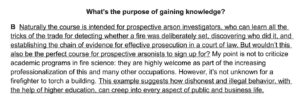
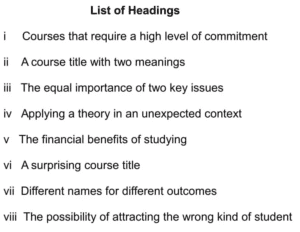
Best approach: Read the headings first, then focus on the overall message of each paragraph. Do not choose a heading only because it repeats one keyword.
2. Matching Information
What you do: Match specific information, examples, explanations, or statements to the paragraph where they appear.
What it tests: Your ability to locate precise information in a longer passage.
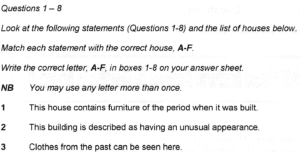
Best approach: Identify keywords in the statement, then scan for synonyms and paraphrases rather than expecting the same wording.
3. Matching Features
What you do: Match people, groups, theories, objects, or categories with characteristics, opinions, or facts from the text.
What it tests: Your ability to recognize relationships between information.
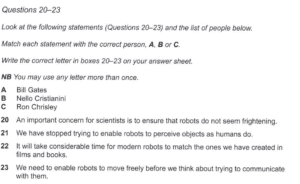
Best approach: Mark the names or categories first, then scan the passage for references to each one and note the associated idea.
4. Matching Sentence Endings
What you do: Match the beginning of a sentence with the correct ending from a list.
What it tests: Understanding meaning, logical relationships, and grammatical fit.
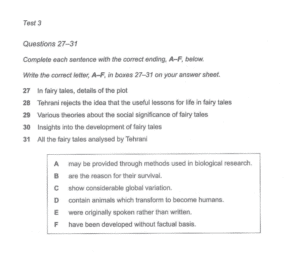
Best approach: Use both meaning and grammar. The correct ending must make sense in the passage and produce a grammatically correct sentence.
5. True / False / Not Given and Yes / No / Not Given
True / False / Not Given is used for factual statements:
- True: the statement agrees with the information in the passage.
- False: the passage clearly contradicts the statement.
- Not Given: the passage does not provide enough information to decide.
Yes / No / Not Given follows the same logic but is used when the question asks about the writer’s views, claims, or opinions.
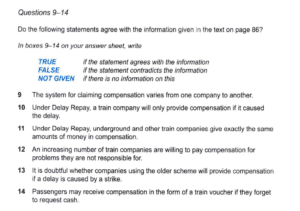
Best approach: Use only the information in the passage. Do not use outside knowledge or assume that something is true simply because it seems logical.
6. Multiple Choice
What you do: Choose the correct answer from several options. Some questions ask for one answer; others may ask for more than one.
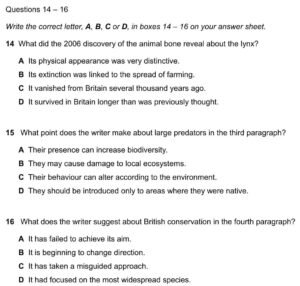
Best approach: Read the question and options carefully, locate the relevant part of the passage, and eliminate options that are only partly correct or not supported by the text.
7. Selecting from a List of Options
What you do: Choose two, three, or another specified number of correct answers from a list.
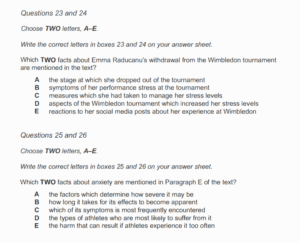
Best approach: Check exactly how many answers are required, then find evidence in the passage for each choice rather than selecting options that merely sound plausible.
8. Choosing a Title
What you do: Select the title that best represents the overall purpose or main idea of the passage.
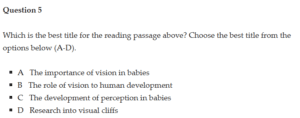
Best approach: Think about the passage as a whole. A good title should cover the central purpose, not only one interesting detail.
9. Short-Answer Questions
What you do: Answer direct questions using words from the passage, usually within a strict word limit.
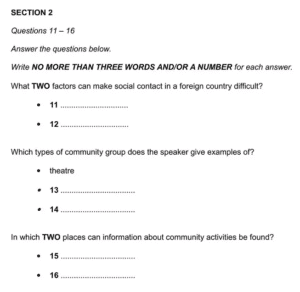
Best approach: Scan for the answer, then check the instruction carefully. If it says NO MORE THAN TWO WORDS, an answer with three words is incorrect.
10. Sentence Completion
What you do: Complete a sentence using a word or short phrase from the passage.
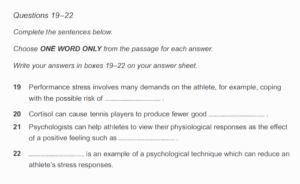
Best approach: Predict what type of word is missing — noun, verb, adjective, number, or phrase — before searching for it in the text.
11. Summary Completion
What you do: Complete a summary of part of the passage using words from the text or a provided list.
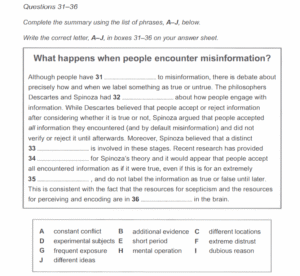
Best approach: Read the whole summary first so you understand the context, then predict the grammatical form of each missing word before locating the matching information.
12. Table Completion
What you do: Fill gaps in a table using information from the passage.
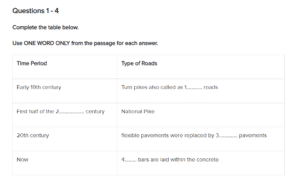
Best approach: Understand the table structure first, then scan for the corresponding category, stage, date, feature, or value in the passage.
13. Flow-Chart Completion
What you do: Complete steps or stages in a process shown as a flow chart.
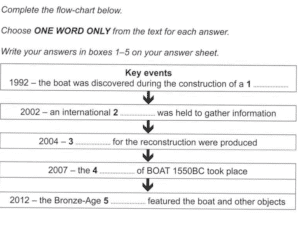
Best approach: Follow sequence language such as first, next, after, then, and finally, and check the word limit carefully.
14. Diagram Label Completion
What you do: Label parts of a diagram using words from the passage.
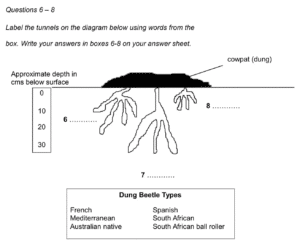
Best approach: Study the diagram first and identify direction, position, labels, and relationships, then locate the part of the text that describes the same object or process.
How Is the IELTS Reading Band Score Calculated?
Each correct Reading answer receives one raw mark. Your raw score out of 40 is then converted to a Band Score from 0 to 9.
There is no negative marking, so an incorrect answer does not remove a mark from a correct one.
The conversion is different for Academic and General Training Reading. Because General Training texts are generally less complex, candidates usually need more correct answers to receive the same Band Score.
Approximate Reading Score Examples
| Correct Answers | Academic Reading | General Training Reading |
|---|---|---|
| 30 / 40 | About Band 7.0 | About Band 6.0 |
| 33 / 40 | About Band 7.5 | About Band 6.5 |
| 35 / 40 | About Band 8.0 | About Band 7.0 |
These are preparation estimates. Exact raw-score thresholds can vary slightly between test versions.
See the full conversion tables in our IELTS Band Scores guide.
What Happens in IELTS Reading on Test Day?
The Reading section lasts 60 minutes. In the standard Listening–Reading–Writing session, Reading follows Listening without a scheduled break.
You cannot use a dictionary or other language-support tools during the test.
In a paper-based Reading test, you need to write your answers on the answer sheet within the 60 minutes because there is no extra transfer time at the end. In IELTS on computer, you enter your answers directly on screen.
The computer-delivered interface can include features such as highlighting text and making notes. Exact interface details and test availability can vary, so follow the instructions from your test centre.
If your original test is eligible for IELTS One Skill Retake, Reading may be retaken as the single skill within the permitted period. Eligibility depends on the test type, centre, and organization accepting the result.
IELTS Reading Tips for a Higher Band Score
1. Read in English every day
Regular reading improves vocabulary, reading speed, and your ability to understand unfamiliar topics. Mix general-interest articles with more analytical or academic texts.
2. Practise skimming and scanning
Use skimming to understand the main idea and structure of a passage. Use scanning to find a specific fact, number, date, name, or keyword quickly.
3. Learn the logic of each question type
Matching Headings requires a different reading approach from True/False/Not Given or Sentence Completion. Practise each format separately before combining them in full tests.
4. Look for paraphrasing, not identical words
IELTS questions often express the same idea using different vocabulary. Train yourself to recognize synonyms, changed word forms, and paraphrased phrases.
5. Respect the word limit
For completion and short-answer questions, follow instructions such as NO MORE THAN TWO WORDS AND/OR A NUMBER. An otherwise correct answer can be marked wrong if you exceed the limit.
6. Manage your 60 minutes actively
A simple starting point is around 20 minutes per section, but do not treat that as a rigid rule. If one question is taking too long, move on and return later if time allows.
7. Review your mistakes after every practice test
Do not only check the final score. Identify why each error happened: vocabulary, paraphrasing, reading too quickly, misunderstanding Not Given, missing a word limit, or spending too long on one question type.
8. Practise under full test conditions
Timed practice helps you develop concentration and decision-making under pressure. Use full Reading sections as well as targeted question-type drills.
How GoIELTS Can Help You Improve IELTS Reading
GoIELTS is an independent IELTS preparation platform designed to help you practise the four IELTS skills in a structured environment.
- Realistic Reading practice: work with IELTS-style questions under timed conditions.
- Flexible practice: train individual skills or use longer mock-style sessions depending on your schedule.
- Performance review: use your results to identify recurring weaknesses and question types that need more work.
- Progress tracking: compare performance over time instead of judging your level from one attempt.
- Estimated readiness: use practice results as an indication of your current level, while remembering that only the official IELTS test produces an official Band Score.
Check your current level with the free IELTS mock test.
Conclusion
Improving IELTS Reading requires more than reading quickly. You need to understand how the three sections work, recognize the different question types, locate paraphrased information, and control your time across all 40 questions.
Start by mastering the question formats that cause you the most mistakes, then combine them in full timed Reading practice. Review every error carefully and track whether your accuracy improves from one test to the next.
With consistent practice in skimming, scanning, paraphrasing, and evidence-based answering, you can approach IELTS Reading with much more confidence and work steadily toward your target Band Score.
Frequently Asked Questions
IELTS Reading contains 40 questions. Both Academic and General Training Reading are divided into three sections, although the way the texts are organized differs between the two versions.
The Reading test lasts 60 minutes. There is no extra transfer time at the end, so you must complete and record all answers within the 60-minute test period.
It depends on the test version. As a preparation guide, Academic Reading Band 7 is commonly around 30–32 correct answers, while General Training Reading Band 7 is commonly around 34–35. Exact raw-score thresholds can vary slightly between test versions.
Yes. Capital letters are accepted as long as the answer is spelled correctly and follows the question instructions. Many test takers choose capitals for clarity, but they are not required.
Practise regularly with timed IELTS-style passages, learn the logic of each question type, use skimming and scanning strategically, review paraphrasing, follow word limits carefully, and analyse every mistake after practice instead of only checking your final score.
About the Content Team at GoIELTS
GoIELTS creates specialized content for IELTS with contributions from writers experienced in education and test preparation.
We follow clear editorial standards for accuracy and quality — read our Editorial Policy


Related Posts
IELTS Writing Task 2: Essay Types, Structure & Tips 2026
October 15, 2025
IELTS Writing Templates for Task 1 & Task 2 2026
November 8, 2025
IELTS Vocabulary: Common Words for All 4 Skills 2026
June 6, 2026

South Korea Scholarships for Saudi Students 2026: GKS, Requirements & Universities
June 10, 2026

Best Universities in the USA for Saudi Scholarship Students 2026
January 19, 2026
How to Understand Your IELTS Mock Test Results and Improve Your Score
September 16, 2026
GoIELTS is an independent training platform specializing in IELTS preparation and is not affiliated with any official organization that owns or administers the IELTS test. The content is provided for educational and informational purposes only and reflects our team’s experience and the latest information available at the time of publication. Information may change without notice. Any use of the information is at the reader’s own responsibility, and results vary depending on each learner’s level and effort. For the latest official requirements, we recommend checking the official IELTS website and the relevant scholarship or sponsoring authority. — Full Disclaimer