
Article Summary
● IELTS Speaking lasts about 11–14 minutes and is divided into three parts: Part 1 interview questions, Part 2 Long Turn / Cue Card, and Part 3 discussion.
● The Speaking test is the same for IELTS Academic and General Training. Reading and Writing are the sections that differ between the two versions.
● Your Speaking Band Score is assessed using four equally weighted criteria: Fluency and Coherence, Lexical Resource, Grammatical Range and Accuracy, and Pronunciation.
● In Part 2, you have one minute to prepare and speak for up to two minutes. Part 3 then develops the topic through more analytical questions.
● Higher-band performance comes from clear idea development, accurate vocabulary and grammar, natural fluency, and pronunciation that is easy to understand — not from memorizing complete answers.
IELTS Speaking is the part of the test where you speak directly with a certified examiner and show how well you can communicate in English in real time.
The Speaking test lasts about 11–14 minutes and is divided into three parts. It is the same for both IELTS Academic and IELTS General Training. You are assessed on fluency and coherence, lexical resource, grammatical range and accuracy, and pronunciation.
In this guide, you will learn exactly how the IELTS Speaking test works, what happens in Parts 1, 2, and 3, how your Speaking Band Score is assessed, what to expect on test day, and how to practise effectively before your exam.
What Is the IELTS Speaking Test?
The IELTS Speaking test is a live conversation with a certified IELTS examiner. It is designed to measure how clearly, accurately, and naturally you can communicate in spoken English.
The test takes around 11–14 minutes and contains three parts. Your performance is recorded and assessed using four official criteria.
Is IELTS Speaking the same in Academic and General Training?
Yes. The Speaking test is the same for IELTS Academic and IELTS General Training. The structure, timing, task types, and assessment criteria are the same in both versions.
Reading and Writing are the sections that differ between Academic and General Training.
How long is the IELTS Speaking test?
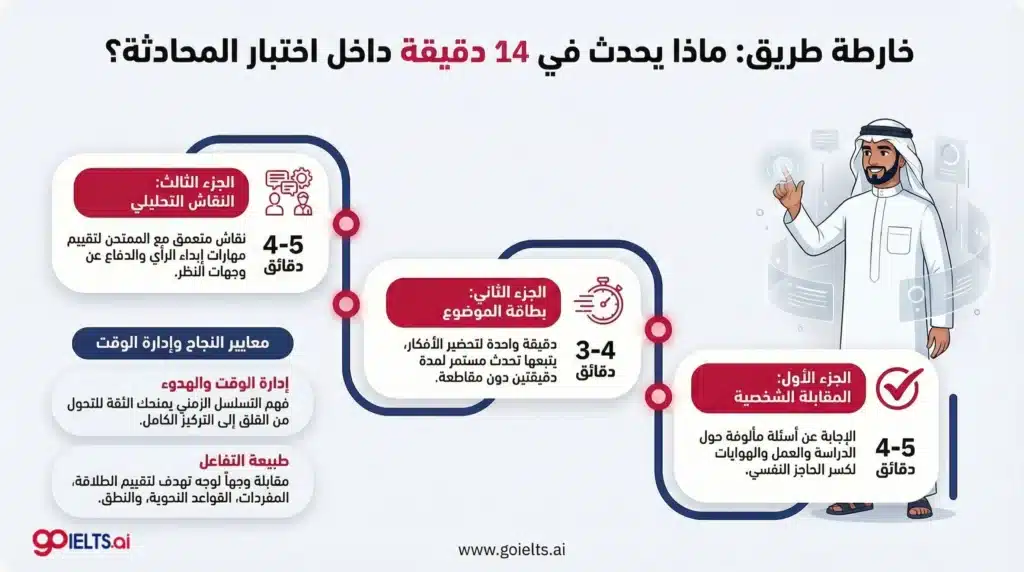
The full Speaking test takes approximately 11–14 minutes:
- Part 1 – Introduction and Interview: around 4–5 minutes.
- Part 2 – Long Turn / Cue Card: around 3–4 minutes, including one minute of preparation.
- Part 3 – Discussion: around 4–5 minutes.
What does IELTS Speaking assess?
Your Speaking performance is assessed in four areas:
- Fluency and Coherence: how smoothly and logically you speak.
- Lexical Resource: the range and appropriateness of your vocabulary.
- Grammatical Range and Accuracy: the variety and accuracy of your grammar.
- Pronunciation: how easy you are to understand.
Want to practise the format first? Try our IELTS Speaking Practice.
The Three Parts of the IELTS Speaking Test
Part 1: Introduction and Interview
In IELTS Speaking Part 1, the examiner asks general questions about familiar areas of your life, such as your home, studies, work, interests, routines, or hobbies.
This part lasts around 4–5 minutes. The goal is to see how comfortably you can give information and opinions about everyday topics.
Common IELTS Speaking Part 1 questions
- What do you do? Do you work or study?
- How often do you listen to music?
- Do you prefer living in a city or in the countryside?
Sample Part 1 response
Question: How often do you listen to music?
“I listen to music almost every day, especially when I’m driving. It usually puts me in a good mood and makes long journeys feel much easier. I’m mostly into Afro music, hip-hop, and R&B, and I sometimes listen to music when I’m working out as well.”
Why this response works well:
- It answers the question directly.
- It adds natural supporting detail.
- It gives a personal example.
- The ideas progress logically instead of sounding memorized.
One strong answer does not guarantee a particular Band Score. Your final Speaking score depends on your performance across the full test and all four assessment criteria.
Part 2: Long Turn / Cue Card
In IELTS Speaking Part 2, you receive a task card — often called a Cue Card — with a topic and several prompts.
You have one minute to prepare. You can make short notes during that minute. You then speak for up to two minutes. The examiner may ask one or two brief follow-up questions at the end.
Common Part 2 topic types
- Places: Describe a memorable place or journey.
- Objects: Talk about a book you recently read.
- People: Describe a person who inspires you.
- Events: Describe an event that made you happy.
- Activities: Describe a hobby you enjoy.
Sample Part 2 response
Question: Describe a book you have recently read.
“One of the most interesting books I’ve read recently is Sapiens by Yuval Noah Harari. It explores human history from early hunter-gatherer societies to the modern world. What I found particularly interesting was the way the author connects history, biology, and social behaviour. The book made me think differently about many things we usually take for granted, so I would definitely recommend it to people who enjoy history or social sciences.”
Why this response works well:
- It follows a clear structure.
- It uses topic-specific vocabulary naturally.
- It develops the answer instead of listing facts.
- It includes a personal reaction and recommendation.
Part 3: Discussion
In IELTS Speaking Part 3, the examiner asks more abstract and analytical questions connected to the Part 2 topic.
This section usually lasts 4–5 minutes. You may need to explain opinions, compare situations, discuss causes and effects, predict future changes, or evaluate advantages and disadvantages.
Common Part 3 question styles
- Opinion: What do you think about…?
- Future / hypothetical: What might happen if…?
- Compare and contrast: How are A and B different?
- Cause and effect: Why does this happen?
- Problem and solution: What can be done about it?
- Advantages and disadvantages: What are the benefits and drawbacks?
- Changes over time: How has technology changed the way people communicate?
Sample Part 3 response
Question: How has technology changed the way people study nowadays?
“Technology has changed education significantly. In the past, students depended mainly on textbooks and face-to-face lessons, whereas today they can access online courses, video tutorials, digital libraries, and AI tools. This has made learning much more flexible and accessible. However, one possible drawback is that some students may rely too heavily on technology instead of developing independent thinking skills. Overall, I think the advantages are greater because learners now have access to far more resources than before.”
Why this response works well:
- It gives a balanced analysis.
- It develops both benefits and drawbacks.
- It includes relevant examples.
- It uses comparison and linking language naturally.
- The speaker makes a clear final judgment.
Explore more IELTS Speaking Questions for Parts 1, 2 & 3.
How Is Your IELTS Speaking Band Score Calculated?
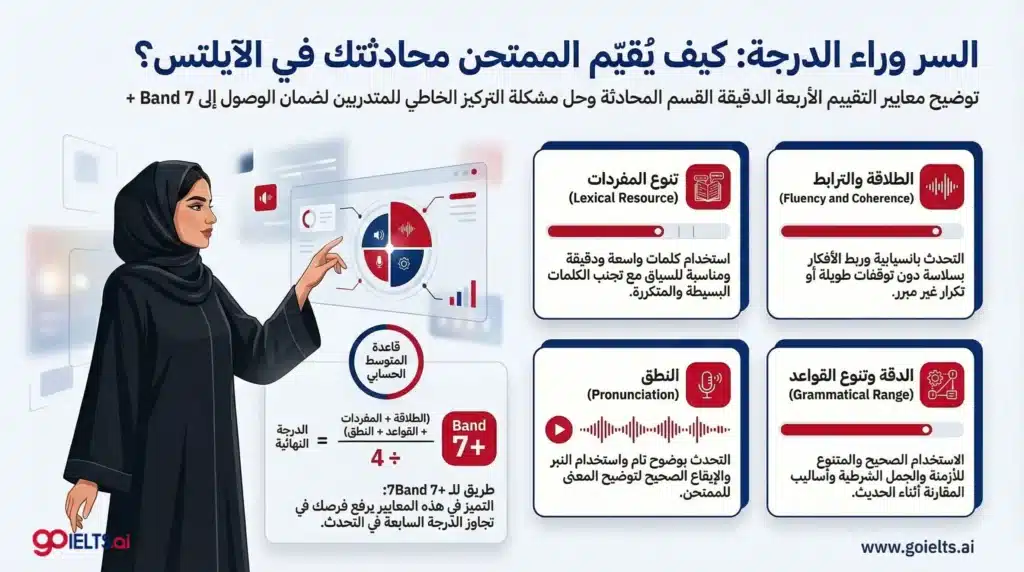
Your IELTS Speaking performance is assessed using four criteria. Each criterion contributes equally to the Speaking score.
1. Fluency and Coherence
This criterion measures how smoothly you speak and how clearly your ideas connect.
You do not need to speak without any pauses at all. Natural pauses are acceptable. Problems arise when hesitation, repetition, or self-correction makes your message difficult to follow.
2. Lexical Resource
This measures the range and appropriateness of your vocabulary, including your ability to explain an idea in another way when you do not know the exact word.
Using “advanced” vocabulary is not enough by itself. Accuracy, natural collocations, and choosing words that fit the context matter more than forcing difficult vocabulary into your answer.
3. Grammatical Range and Accuracy
This criterion looks at the variety and accuracy of your grammar.
Higher-band performance usually includes a mix of simple and complex structures used with good control. Accuracy matters more than using complicated grammar you cannot manage reliably.
4. Pronunciation
Pronunciation is about how easy you are to understand. You do not need a British or American accent.
Examiners listen to features such as individual sounds, word stress, sentence stress, rhythm, and intonation, but intelligibility is the main goal.
Speaking score example
If your four criterion scores were:
- Fluency and Coherence: 7.0
- Lexical Resource: 6.5
- Grammatical Range and Accuracy: 6.0
- Pronunciation: 6.5
The average would be:
(7.0 + 6.5 + 6.0 + 6.5) ÷ 4 = 6.5
Your final Speaking Band would therefore be around 6.5.
Use the IELTS Band Score Calculator to understand how your skill bands affect your overall result.
What Happens on IELTS Speaking Test Day?
Before your Speaking test, follow the instructions from your test centre and bring the identification document required for your booking.
The exact scheduling arrangement can vary by test centre, location, and test product. Your Speaking interview may be scheduled on the same day as the Listening, Reading, and Writing sections or on a separate date.
Whether your Listening, Reading, and Writing sections are taken on computer or on paper, the Speaking format, timing, and assessment criteria remain the same. You still complete a live Speaking test with a certified examiner.
For some IELTS products or locations, the live interaction may be delivered by video call. Always follow the details in your official booking confirmation.
Skills You Need for a Higher IELTS Speaking Band
To move toward Band 7 or above, focus on the skills that directly support the four assessment criteria.
1. Develop fluency without rushing
Speak continuously enough to develop your ideas, but do not try to speak as fast as possible. Fluency is about control and flow, not speed.
2. Extend your answers
Avoid giving only one-sentence answers when the question allows more development. Add a reason, example, comparison, or consequence.
3. Build usable vocabulary
Do not simply replace common words with difficult synonyms. Learn vocabulary in phrases and collocations so you can use it naturally in conversation.
4. Use a range of grammar you can control
Practise past, present, and future forms, comparisons, conditionals, relative clauses, and other useful structures — but prioritize accuracy.
5. Improve pronunciation for clarity
Work on word stress, sentence stress, connected speech, and difficult sounds. Your goal is to be easy to understand, not to imitate a native-speaker accent.
6. Organize ideas naturally
Use linking expressions such as for example, because, however, and on the other hand only when they fit the relationship between ideas.
How to Prepare for IELTS Speaking with GoIELTS
GoIELTS is an independent IELTS preparation platform designed to help you practise Speaking in a structured way before test day.
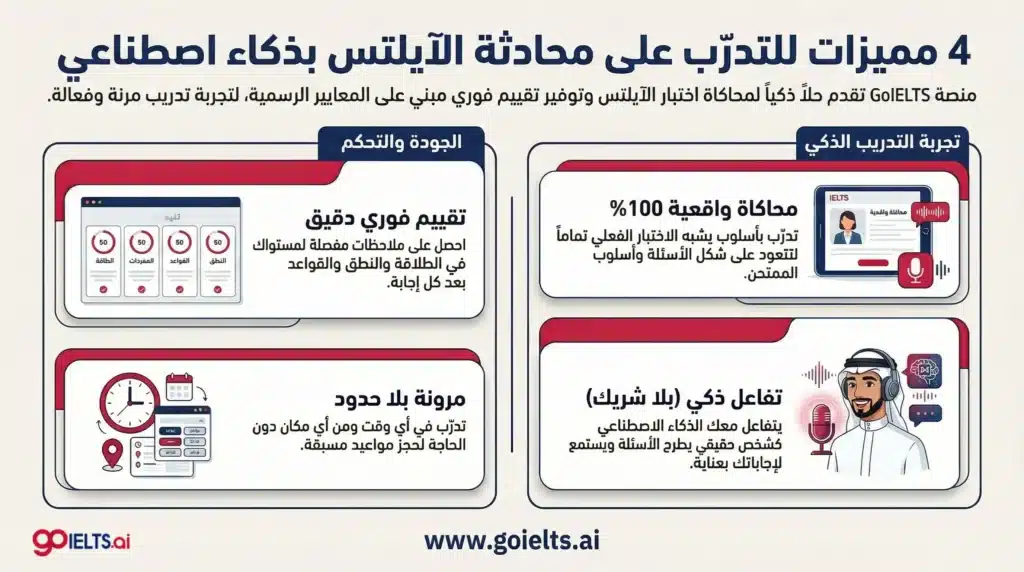
1. Practise the real three-part structure
Use realistic Speaking questions so that Part 1, Part 2, and Part 3 feel familiar before test day.
2. Get automated feedback on your performance
GoIELTS can provide preparation feedback on areas such as fluency, vocabulary, grammar, and pronunciation so you can identify repeated weaknesses.
This is a preparation tool and does not replace an official IELTS examiner or official IELTS result.
3. Practise flexibly
You can work on individual questions, short practice sessions, or longer mock-style sessions depending on how much time you have available.
4. Practise without needing a speaking partner
The GoIELTS AI Speaking Partner lets you practise a live-style conversation and respond verbally to IELTS-style prompts.
5. Combine practice with question review
Use the IELTS Speaking Questions guide to build topic familiarity, then use Speaking Practice to apply what you have learned under more realistic conditions.
Conclusion
The IELTS Speaking test is much easier to manage when you understand the format before test day.
Remember the structure: familiar questions in Part 1, a two-minute Long Turn in Part 2, and a deeper discussion in Part 3. Your goal is not to memorize perfect answers. Instead, focus on speaking clearly, developing ideas naturally, using vocabulary accurately, controlling your grammar, and making your pronunciation easy to understand.
Regular speaking practice is the most effective way to reduce hesitation and build confidence. Use realistic questions, record or review your answers, identify repeated weaknesses, and practise again with one specific improvement goal each time.
Frequently Asked Questions
IELTS Speaking has three parts and takes about 11–14 minutes. Part 1 is an interview, Part 2 is a Long Turn using a Cue Card, and Part 3 is a deeper discussion related to the Part 2 topic.
No. The Speaking test is the same for IELTS Academic and IELTS General Training. The structure, timing, topics, and assessment criteria are the same. Reading and Writing are the sections that differ between the two versions.
Yes. If you do not hear or understand a question clearly, you can politely ask the examiner to repeat it. For example: “Sorry, could you repeat that, please?” Avoid asking repeatedly unless you genuinely need clarification.
Nervousness itself is not directly penalized. Short natural pauses are also normal. However, if hesitation, repetition, or difficulty expressing ideas repeatedly affects your fluency, clarity, grammar, vocabulary, or pronunciation, it can influence your score through the relevant assessment criteria.
The Speaking format, timing, and assessment criteria are the same whether the other IELTS sections are taken on paper or computer. Scheduling and delivery arrangements can vary by test centre or test product, so follow the details in your booking confirmation.
About the Content Team at GoIELTS
GoIELTS creates specialized content for IELTS with contributions from writers experienced in education and test preparation.
We follow clear editorial standards for accuracy and quality — read our Editorial Policy


Related Posts
IELTS Resources Hub 2026: Best Websites, Books & Practice Tools
November 4, 2025
IELTS Writing Task 1: Templates, Examples & Tips 2026
October 11, 2025

IELTS Band Scores Explained: Score Tables & Calculation 2026
September 20, 2025
IELTS Vocabulary: Common Words for All 4 Skills 2026
June 6, 2026

Saudi Cultural Scholarship Program 2026: Requirements, Majors & Application
October 11, 2025
IELTS Writing Test Guide: Task 1, Task 2 & Band Scores 2026
September 1, 2025
GoIELTS is an independent training platform specializing in IELTS preparation and is not affiliated with any official organization that owns or administers the IELTS test. The content is provided for educational and informational purposes only and reflects our team’s experience and the latest information available at the time of publication. Information may change without notice. Any use of the information is at the reader’s own responsibility, and results vary depending on each learner’s level and effort. For the latest official requirements, we recommend checking the official IELTS website and the relevant scholarship or sponsoring authority. — Full Disclaimer