
Article Summary
- Recommended IELTS preparation podcasts include IELTS Energy English 7+, IELTS Podcast, My IELTS Classroom and Your Guide to IELTS (Dalilak lil IELTS) for Arabic-speaking learners.
- Podcasts can support Listening comprehension, Speaking fluency and academic vocabulary development.
- Regular listening helps learners become familiar with different accents and IELTS-related question topics.
- Combine podcasts with structured practice, mock tests and an assessment of your current level.
- Connecting audio learning with practical exercises can help you work towards a higher IELTS band with confidence.
Podcasts have become a valuable tool for preparing for the IELTS test, particularly for students with limited time or those who find conventional study methods repetitive.
Instead of relying on books alone, you can develop your English skills by listening to IELTS podcasts every day, while driving, walking or even before bed.
In this guide, we explore ten of the best IELTS podcasts, what each programme offers, the learners it may suit and how to turn listening into practical Listening and Speaking preparation without using podcasts as a substitute for official IELTS practice tests.
10 of the best IELTS podcasts recommended for test preparation
1. IELTS Energy English 7+
IELTS Energy English 7+ from the All Ears English team specialises in strategies for IELTS Academic and General Training. Episodes cover Speaking, Writing, Listening, Reading and vocabulary. The number 7+ is part of the programme’s name, not a guarantee of achieving that score.
What IELTS Energy English 7+ offers
The podcast provides focused preparation content and practical strategies for every IELTS section:
- Speaking: tips for reducing anxiety, organising ideas, using natural expressions and making a strong impression on the examiner.
- Writing skills: advice for Task 1 (describing charts and diagrams in Academic IELTS or writing letters in General Training) and Task 2 (essay writing).
- Listening and Reading: strategies for improving comprehension of passages and recordings and expressing ideas clearly.
- Vocabulary and grammar: advanced vocabulary, including phrasal verbs and idioms, and grammar relevant to the test.
- English-speaking culture: opportunities to learn about American culture and the everyday habits of native English speakers.
Where to listen to IELTS Energy English 7+
The podcast is described as releasing episodes weekly. You can find it on:
2. IELTSCast
IELTSCast: Weekly Shadowing Exercises for IELTS Speaking is an educational podcast hosted by Ryan Higgins. It is designed to help IELTS candidates improve their Speaking skills through shadowing: listening to model conversations presented as Band 9-level examples and repeating them with similar intonation and rhythm to develop pronunciation, fluency and vocabulary.
How the shadowing exercises work
- Learn: listen to high-quality model conversations about IELTS topics such as life and work.
- Try: repeat what you hear, attempting to imitate the speaker as closely as possible. This is the essence of shadowing.
- Apply: use the vocabulary and expressions you have learned in your daily conversations, and consider practising with a conversation partner.
Learning objectives
- Improve pronunciation.
- Increase fluency.
- Learn new expressions and vocabulary.
- Prepare for IELTS Speaking topics and questions.
Key features of IELTSCast
- Shadowing exercises: weekly exercises designed to improve pronunciation and fluency through repeating sentences after the speaker.
- Episode topics: questions similar to IELTS Speaking topics, such as describing places and personal experiences.
- Ongoing content: check the latest 2026 episodes on platforms such as Apple Podcasts and Libsyn.
- Host: Ryan Higgins, whose blog is ieltsspeakingblog.com.
- Speaking practice: particularly useful for students who struggle to express ideas fluently or want to develop their intonation and spoken English for IELTS.
Where to listen to IELTSCast
3. IELTS VIP Podcast
IELTS VIP Podcast is an educational audio programme hosted by Chris Pell, founder of IELTS Advantage. It aims to help IELTS candidates improve their scores through practical advice, strategies and accessible explanations of the four skills: Listening, Reading, Writing and Speaking.
What IELTS VIP offers
- Specialist advice: strategies for particular skills, such as connected speech in episode 8, which can support independent pronunciation practice.
- Test section explanations: content on Writing, Speaking, Reading, Listening and vocabulary.
- Free content: part of the free resources provided by IELTS Advantage to simplify test preparation.
- Complementary resources: the podcast complements IELTS Advantage’s other resources, including challenges and more detailed training courses.
Where to listen to IELTS VIP
The podcast includes more than 25 episodes and can be found on:
4. IELTS Podcast
IELTS Podcast offers a large library of educational episodes about test skills, especially strategies for Writing, Speaking, Reading and Listening. Use its episodes to understand question types and common mistakes, and check publication dates whenever a topic concerns changing test policies.
What IELTS Podcast offers
Strategies for all four IELTS sections:
- Listening: predicting answers, dealing with distractors and improving concentration.
- Reading: finding answers quickly, managing time and understanding complex questions.
- Writing: understanding task requirements, organising ideas and avoiding common errors.
- Speaking: developing fluency, expanding ideas and choosing vocabulary appropriate to your target band.
Specialised audio guidance for IELTS Writing: many episodes cover Task 1 and Task 2 step by step, effective answer structures, examples of ideas to develop in the test, and common mistakes that can cost marks. The explanations are accessible to learners who find academic writing difficult.
Time management and exam pressure: advice on managing time during the test, handling stress and anxiety, and planning preparation before test day.
Success stories and real experiences: episodes feature students who achieved high scores sharing their experiences, study plans and practical tips that helped them improve. These can provide motivation and a realistic perspective on preparation.
Where to listen to IELTS Podcast
5. Magoosh IELTS
The free Magoosh IELTS podcast from Magoosh IELTS Prep, hosted by Elliot Friesen, focuses on essential English vocabulary across common test topics such as the environment, technology and travel. It also offers practical Writing and Speaking advice to help students understand important words and use them appropriately.
What Magoosh IELTS offers
- Vocabulary lessons: episodes teaching important words for IELTS topics such as the environment, travel and work, with explanations of their use in different contexts.
- Writing and Speaking advice: useful sentence patterns, improved sentence construction and general test tips.
- Dialogue episodes: conversations featuring vocabulary introduced in earlier lessons, demonstrating practical usage.
- Test preparation: a broad range of IELTS-related topics with a focus on vocabulary learners need.
Where to listen to Magoosh IELTS
6. IELTS Prepare by IDP
IELTS Prepare by IDP is a free ten-episode video and audio podcast series launched by IDP, an official IELTS co-owner and test partner. It guides candidates from their first introduction to IELTS through to test day.
What IELTS Prepare by IDP offers
- Clear explanations of the test structure and the Academic and General Training test types.
- Practical tips and strategies for Listening, Reading, Writing and Speaking.
- Guidance on what to expect on test day, helping candidates prepare mentally and practically.
- Interviews with IELTS experts from IDP, answering common questions and sharing their experience.
- Free preparation materials and resources accompanying episodes or available through the app.
This series offers a free preparation resource from an official IELTS partner, with clear and structured guidance.
Where to listen to IELTS Prepare by IDP
7. My IELTS Classroom
My IELTS Classroom is an educational podcast specialising in IELTS preparation, presented by British IELTS experts Shelly Cornick and Nick. It is designed to help learners through practical advice, clear test strategies for all four skills, and discussions debunking common IELTS myths, in an engaging weekly format.
It is a specialist resource for learners who want to understand assessment criteria, common Writing and Speaking errors and question strategies. Its usefulness depends on the learner’s ability to follow explanations in English and the particular skill being studied.
What My IELTS Classroom offers
- Detailed explanations: writing introductions for agree/disagree essays, using notes effectively in Listening and improving grammar, including subject–verb agreement.
- IELTS myth-busting: discussion of common beliefs about the difficulty of achieving high scores or whether certain test centres are easier than others.
- Varied topics: motivation, pre-test stress, administrative aspects of the test, and common Speaking topics such as technology and the environment.
- Supporting resources: episode transcripts where available, explanatory articles and additional exercises on the official blog.
The podcast’s learning goals
- Make the IELTS preparation journey smoother for students.
- Provide engaging, interactive learning rather than purely theoretical instruction.
- Complement podcast learning with advanced video lessons, live classes and intensive courses on the website.
Where to listen to My IELTS Classroom
8. Espresso English
Espresso English is a general English-learning podcast hosted by Shayna, focusing on grammar, vocabulary, useful phrases and pronunciation in short lessons. It can help learners strengthen their foundations before IELTS, but it does not simulate the official Listening test.
Its concise, focused lessons cover essential language skills, including common expressions and idioms. Like an espresso, each lesson is designed to be quick and concentrated. It is particularly suitable for beginner and intermediate learners with limited study time.
What Espresso English offers
- Grammar and vocabulary: simple grammar explanations and vocabulary development.
- Everyday expressions and idioms: phrases used naturally by English speakers.
- Short, practical lessons: episodes often lasting five to ten minutes, with ideas you can apply immediately.
- Useful everyday topics: distinctions between similar words such as in, inside and into, polite expressions, food vocabulary and phrasal verbs.
- Pronunciation and listening: practice understanding American pronunciation and natural speaking speeds.
- Free resources: PDFs and short quizzes for practice and revision where provided.
Related reading: Best IELTS YouTube channels for preparation.
Where to listen to Espresso English
- Spotify
- Apple Podcasts
- YouTube Music
- YouTube
- Official Espresso English podcast website, which also offers paid advanced courses and e-books.
9. IELTS Speaking for Success
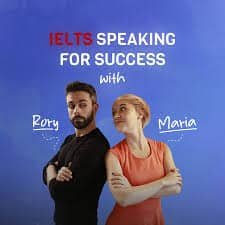
IELTS Speaking for Success is a free educational audio podcast presented by Maria and Rory, helping learners improve spoken English and prepare for the Speaking test.
It covers practice topics similar to IELTS Speaking subject areas, discussing example answers, ideas and useful vocabulary for all three parts. Progress requires producing independent answers and practising the four Speaking assessment criteria.
What IELTS Speaking for Success offers
- Speaking topic analysis: discussion of popular and recent practice topics for Parts 1, 2 and 3.
- Model answers: examples of strong, natural responses to help learners understand how to develop their own answers.
- Useful vocabulary and grammar: explanations of words and structures relevant to the test context.
- Transcripts: episode texts for easier review where available, subject to the provider’s access arrangements.
- General English improvement: opportunities to develop fluency, pronunciation and familiarity with natural spoken English.
Who is it for?
- IELTS candidates aiming to improve their Speaking score.
- Learners seeking to speak more fluently and naturally.
- English teachers looking for practical training material for their students.
Where to listen to IELTS Speaking for Success
- Apple Podcasts
- Spotify
- YouTube
- Official Success with IELTS website, with supporting transcripts and vocabulary resources.
10. Your Guide to IELTS (Dalilak lil IELTS)
Your Guide to IELTS (Dalilak lil IELTS) is an Arabic-language podcast hosted by Abdulrahman Hegazy. It includes English listening episodes with vocabulary explanations and review in Arabic. It is particularly useful for Arabic-speaking learners who want to build comprehension gradually with support in their first language.
What makes it different? Some episodes progress from listening to an explanation of difficult vocabulary and then listening again, as in Daily IELTS Listening #435. It is a supplementary resource, not a substitute for timed official Listening practice.
Where to listen: Your Guide to IELTS on Apple Podcasts.
Why are podcasts useful for IELTS preparation?
Podcasts provide daily exposure to English in natural contexts, particularly supporting Listening and Speaking development. Regular listening can help you:
- Improve listening comprehension naturally.
- Become familiar with pronunciation and different accents.
- Learn vocabulary and sentences relevant to IELTS topics.
- Explore ideas for Speaking and Writing in an alternative format.
- Make learning more varied alongside conventional study materials, including IELTS preparation books and official samples.
For many learners, podcasts can be a valuable part of a study plan. See our guide to how to study for IELTS effectively.
How to use IELTS podcasts effectively
Some students listen to podcasts without noticing meaningful improvement because they listen without a clear practice routine. Try these four steps:
1. Avoid passive listening
Focus on what the speaker is saying rather than simply playing the audio in the background.
2. Listen again
Listen to an episode two or three times:
- First, to understand the main idea.
- Second, to identify new vocabulary.
- Third, to imitate pronunciation.
3. Take notes
Write down new words, ideas for Speaking and useful expressions, including an example of how each expression is used. Then paraphrase it in your own words.
4. Combine podcasts with regular practice
After each episode, speak about the topic for one minute and write a short paragraph using the new vocabulary.
Is listening to an IELTS podcast the same as Listening test practice?
No. There is a difference between listening to explanations of exam questions, improving English comprehension through conversations and transcripts, and completing a timed Listening practice test. The IELTS Listening test contains four parts and 40 questions, and each recording is played once.
Use episodes to understand strategies, then test your ability to apply them through IELTS Listening practice with appropriate questions and timing.
How GoIELTS can help you get more from IELTS podcasts
GoIELTS can help you turn podcast listening into focused IELTS preparation:
Turn podcasts into a clear study plan
Use podcasts as a supplementary resource, then apply what you learn through GoIELTS exercises for your target skills. After an episode about Speaking development, practise a new question and review the available performance feedback.
Improve Listening and Speaking through practical exercises
GoIELTS helps you apply what you hear through flexible Listening and Speaking practice based on IELTS-style questions, supporting comprehension, fluency and pronunciation.
Connect podcasts to IELTS-style questions
Identify the skill discussed in an episode, then select a separate exercise on that skill in GoIELTS if available. If you learn how to organise ideas for Speaking Part 2, speak about a new topic rather than simply repeating the model answer from the episode.
Apply the vocabulary and structures you hear when answering Listening questions, developing organised Speaking responses, improving Writing ideas and examples, and understanding Reading passages more accurately. This makes podcast listening useful across your preparation, not just as a listening activity.
Save time and study more efficiently
Use the platform’s feedback and performance analysis to focus your efforts on areas that need improvement. This can help you use preparation time more effectively and work towards your target score.
Practise with an IELTS-style mock test
GoIELTS offers mock tests to help you practise skills, manage time and become familiar with IELTS question types. Use estimated results to identify areas for review, rather than treating them as guarantees of your official score.
These tests can help you assess your readiness for each section before booking the official test and become more familiar with test-day conditions, which may reduce anxiety and build confidence.
Create a free account and start preparing for IELTS.
Who should use IELTS podcasts?
IELTS podcasts can be useful for:
- Busy students who do not have a fixed study schedule.
- Learners who struggle with Listening.
- Students who find traditional learning methods repetitive.
- Anyone who wants to improve their English naturally rather than memorising answers.
Podcasts vary in speaking speed and vocabulary difficulty. Choose an episode whose main idea you can understand, use the transcript when available and avoid choosing a programme solely because its name mentions your target band.
Final thoughts
Whether you choose Your Guide to IELTS for Arabic-supported listening practice or IELTS Speaking for Success to understand how to develop spoken answers, follow every listening session with practical application and a review of your mistakes.
Success in IELTS depends less on the number of resources you collect than on choosing useful materials and using them consistently.
Explore our guide to the best IELTS preparation resources.
Frequently Asked Questions
The best choice depends on your goals and current level. IELTS Energy English 7+ is an option for learners aiming for Band 7 or higher, Your Guide to IELTS (Dalilak lil IELTS) is particularly useful for Arabic-speaking learners, and IELTSCast offers shadowing exercises for Speaking.
There are no unified, reliable figures identifying the most-watched or most-listened-to IELTS podcast across all platforms. IELTS Energy English 7+ is a well-known programme, but compare podcasts based on your target skill, level and the recency of episodes.
No single podcast can be ranked number one worldwide in absolute terms. All Ears English is a well-known English-learning network, and IELTS Energy English is its dedicated IELTS preparation programme.
Choose according to your goal: IELTS Podcast and My IELTS Classroom for exam strategies, IELTS Speaking for Success for spoken answers, and Your Guide to IELTS for Arabic-supported listening. Espresso English helps build general English foundations but does not replace official IELTS questions.
No. Podcasts are useful but not sufficient on their own. Combine listening with practical exercises, speaking or writing using new vocabulary, and timed IELTS practice tests. Use GoIELTS to help assess your readiness.
There is no official weekly frequency that guarantees a higher band. Choose a sustainable routine and spend time after each episode reviewing challenging passages, a manageable number of new words and one practical idea for Speaking or Listening. Practice quality matters more than the number of episodes.
Yes. Options such as Espresso English and Your Guide to IELTS (Dalilak lil IELTS) provide short episodes, accessible language and clear explanations to help learners build a foundation before moving to more advanced content.
Related Posts
About the content team at GoIELTS
GoIELTS produces specialist IELTS content written by experienced educational writers.
We follow rigorous editorial standards — Read our editorial policy


GoIELTS is an independent training platform specializing in IELTS preparation and is not affiliated with any official organization that owns or administers the IELTS test. The content is provided for educational and informational purposes only and reflects our team’s experience and the latest information available at the time of publication. Information may change without notice. Any use of the information is at the reader’s own responsibility, and results vary depending on each learner’s level and effort. For the latest official requirements, we recommend checking the official IELTS website and the relevant scholarship or sponsoring authority. — Full Disclaimer