
Article Summary
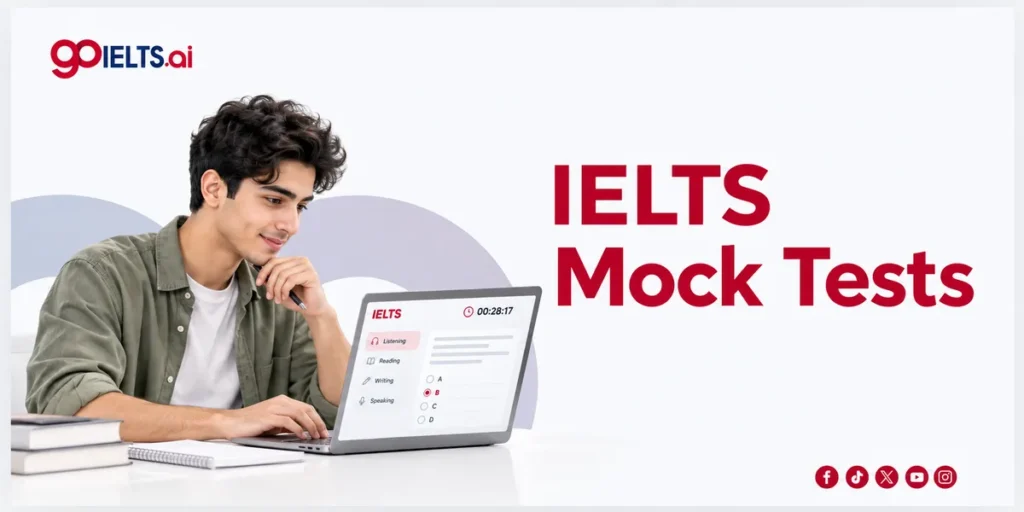
● An IELTS mock test helps you learn question formats and timing, identify weak skills and prepare more confidently for exam day.
● Choose an IELTS practice website based on realistic test simulation, the credibility of its questions, feedback quality, four-skill coverage, ease of use and value for money.
● Helpful options include IELTS.org, British Council, IDP IELTS and GoIELTS, complemented by teaching resources such as IELTS Liz. Not every practice resource is a full timed mock test.
● Sit practice tests under realistic conditions, examine errors by question type and turn feedback into targeted Listening, Reading, Writing and Speaking exercises.
● You might take a mock test every one to two weeks while preparing, but there is no required number. Training results, especially AI-generated Writing and Speaking band estimates, do not guarantee official IELTS scores.
Looking for the best IELTS mock test website before your real exam? Practising with a reliable test can help you understand IELTS question formats, manage time, identify weak areas and prepare more confidently. However, even a high-quality mock test is a practice and diagnostic tool, not a guarantee of your official IELTS result.
This guide compares official IELTS practice resources and independent preparation platforms. It explains what each option offers, how to choose the right service, and how to turn mock-test feedback into a practical study plan.
Best IELTS Mock Test Websites: Detailed Comparison 2026
We review five well-known resources: IELTS.org, British Council, GoIELTS, IDP IELTS and other specialist learning sites. Some offer free sample questions or lessons, while others offer timed practice or performance reports. Check each resource’s description before assuming it is a complete, fully scored mock examination. If a platform estimates a band, consult our IELTS Band Scores guide to understand the scale; practice predictions are not official results.
1. IELTS.org: Official IELTS Sample Questions
The official IELTS website provides practice questions and information to help you become familiar with Listening, Reading, Writing and Speaking. It is a trusted reference for test formats and assessment criteria; not every sample is a complete timed exam with individual marking.
Advantages: official-source samples, guidance for each skill, and access to published marking criteria.
Limitations: free sample sets are finite; detailed personal analysis may not be available; Arabic-language explanations may be limited.
Best for: all learners, especially those starting to explore IELTS. Combine official samples with additional timed practice and feedback when you need more intensive preparation. Explore our IELTS preparation resources for other options.
2. British Council: IELTS Ready and Practice Tests
British Council provides official preparation materials, including IELTS Ready, free practice exercises and computer-test familiarisation resources. Additional materials may be available through IELTS Ready Premium, depending on booking and eligibility. A familiarisation activity helps you understand the computer test interface but does not automatically supply an official Writing or Speaking score.
Advantages: official question-format practice, learning resources and computer-test familiarisation.
Limitations: features vary across free and premium offerings, reliable internet may be necessary and not all practice resources provide full four-skill feedback.
Best for: learners who want official-style questions and an introduction to the digital exam environment. See the British Council IELTS practice tests.
3. GoIELTS: Online Mock Tests and Practice Feedback
GoIELTS offers digital IELTS-style practice and feedback tools designed to help learners review errors and monitor progress. The platform also supports the preparation needs of Arabic-speaking learners. A GoIELTS mock test is still a training experience rather than an officially supervised IELTS examination.
Advantages: options for online mock and skill-specific practice, feedback or reports depending on the activity, and an opportunity to start with a free diagnostic practice test. Writing and Speaking practice may include AI-supported feedback about specific areas for improvement.
Important limitation: an automated Writing or Speaking band estimate is not an official IELTS score, and the depth of feedback varies by the available service. Use the feedback to plan targeted exercises, not as a promise that you will achieve the same official band.
Best for: learners who want to combine digital test practice with error review and a structured study routine. Explore the GoIELTS mock test, read our IELTS preparation guide, or create an account to practise.
4. IDP IELTS: Official Practice Materials
IDP is an official IELTS partner and publishes preparation materials, practice questions and exam guidance. Some of these resources are individual exercises rather than full-length simulations, so check the details before starting.
Advantages: trustworthy provider materials, question samples across the IELTS skills, instructional videos and accessible online resources.
Limitations: some activities have limited scoring information or personal feedback; access, formats and languages vary; not every exercise is a complete mock examination.
Best for: learners seeking another official IELTS preparation source alongside their regular study programme. Visit IDP IELTS Practice Tests.
5. Other Helpful Sites: IELTS Liz and IELTS Advantage
IELTS Liz offers lessons, explanations and skill-based practice. IELTS Advantage focuses on IELTS strategies and task types. Both can complement a preparation routine, but their educational content should not automatically be considered a replacement for a complete timed mock test.
Use these resources to understand question types and build foundations, then add a complete mock-test experience when you need to practise under time pressure. The right combination depends on your current level, target band and budget.
Prefer a PDF? Printable practice questions can help you review tasks and answer formats, but a PDF alone does not simulate computer-test navigation, integrated audio or a live Speaking interview. Check whether the file includes listening audio and answer keys. Our IELTS PDF library is another place to explore legally available study materials.
Why Take an IELTS Mock Test Before the Real Exam?
Timed practice can reveal problems that ordinary studying may hide, such as slow answers, unfamiliar question types, difficulty concentrating or ineffective strategies. However, completing a large number of tests does not necessarily improve your band score; the benefit comes from analysing mistakes and acting on them.
1. Practise Under Realistic Test Conditions
The exam environment can feel unfamiliar and demanding. A clock is running, tasks arrive in a fixed order and you have limited time to reconsider answers. A good timed mock test lets you practise decisions under pressure, control your pace and get used to completing tasks without unnecessary breaks.
Reading an article at home with unlimited time is different from working through a full Reading section in 60 minutes. Familiarity with the timing and question layout can make the official test experience feel less surprising.
2. Identify Strengths and Weaknesses
You may understand Reading passages well but spend too long on early questions, leaving too little time for the final passage. A mock test can reveal that pattern. A useful performance report may also show whether mistakes arise from comprehension, time management or a particular question format.
Instead of practising Reading generally, you can focus on the task type that causes recurring problems, such as matching headings or True/False/Not Given. The more specific the evidence, the more focused your practice can become.
3. Track Progress Over Time
Take diagnostic tests at intervals and compare results for each IELTS skill. For example, if your Listening practice estimate moves from Band 5.5 to 6.0 after two weeks of focused work, that may indicate progress. If the estimate stays the same, reconsider your preparation method. Treat individual scores cautiously: differences in test difficulty and marking can affect practice results.
Repeated practice under reasonable conditions may also help build confidence, provided you review what went wrong rather than relying on the score alone.
| Aspect | Studying IELTS Concepts | Taking a Mock Test |
|---|---|---|
| Understanding content and strategies | Strong potential | Strong potential with review |
| Practising real time limits | Not necessarily | Yes, when properly timed |
| Estimating your current performance | Indirect | Useful indication, not an official score |
| Getting used to time pressure | Limited | Yes, to some extent |
| Finding specific weaknesses | Possible, but may be limited | Potentially detailed when feedback is available |
| Building test-day confidence | Through preparation | Through realistic practice |
How to Choose the Best IELTS Mock Test Website
Not every mock-test website delivers the same educational value. Some have old or low-quality questions; others give a number without explaining mistakes. Before choosing a service, decide whether you need official sample questions, a timed simulation, or a feedback service. These are related but different products.
1. How Closely Does It Simulate the Real IELTS Test?
Compare the number of questions, time limits, task types and answer-entry methods with the official IELTS format. If you will take IELTS on a computer, practise reading on screen, navigating tasks and typing Writing responses. A similar-looking interface does not guarantee identical difficulty or an identical score. Also check computer vs paper IELTS formats and the official IELTS delivery update for changes to exam formats.
Some independent tests may be easier or harder than the official exam. Look for transparent information about the source of questions, how materials were developed and how recently the resource was reviewed. Avoid a platform that claims it can guarantee the exact score you will achieve.
2. Quality of Results and Performance Analysis
A final band estimate alone does not tell you what to improve. A useful report should show which skill or question type caused difficulties, where time was lost and, where available, how the response relates to published assessment criteria.
For example, a report showing repeated mistakes in Reading matching tasks is more actionable than a single overall score. GoIELTS and other independent platforms may provide different types of practice feedback depending on the selected test and service. Verify what level of reporting is actually included.
3. Coverage of All Four IELTS Skills
Many sites emphasise Listening and Reading because they are easier to mark automatically. However, learners also need opportunities to practise Writing and Speaking. For a complete preparation experience, consider:
- Listening: approximately 30 minutes, 40 questions across four parts. Computer IELTS does not provide the same ten-minute answer-transfer period used in the traditional paper test.
- Reading: 60 minutes with passages and task types appropriate to Academic or General Training.
- Writing: 60 minutes for Task 1 and Task 2.
- Speaking: approximately 11–14 minutes across three parts, officially assessed by an IELTS examiner.
Check whether a practice platform covers the Academic and General Training versions you need. For Writing, distinguish Task Achievement for Task 1 from Task Response for Task 2, along with Coherence and Cohesion, Lexical Resource, and Grammatical Range and Accuracy. Speaking assessment also considers fluency and coherence, vocabulary, grammar and pronunciation. An AI estimate remains an estimate, regardless of the criteria used.
4. Price and Value for Money
Free resources from IELTS.org, British Council and IDP can be a strong starting point. Independent platforms may also offer a free diagnostic test. Paid services can be worthwhile when they provide additional relevant practice, detailed reporting or meaningful feedback, but a higher price is not proof of better accuracy.
Before subscribing, compare the number and type of tests included, the skills covered, how feedback is generated, access limits and the cancellation terms. Start with free resources, then consider extra support only when it addresses a genuine need in your preparation.
5. Ease of Use and Support
Choose a reliable website that loads quickly, works on your device and makes the instructions clear. If you are practising computer-delivered IELTS, using a desktop or laptop may better reflect your test-day experience than a phone. Candidates who prefer explanations in Arabic may value an Arabic interface or Arabic-language support, but the language of the actual test remains English.
Good technical support is also useful if a recording does not play, an answer fails to save or a practice report is unavailable. Review the service’s support options and practical usability before investing money.
How to Get the Most from a Free Online IELTS Mock Test
Taking a test is only the beginning. The real value comes from how you examine the results, recognise repeated patterns and adjust your preparation. Use the following six-step approach whether your test is free or paid.
1. Take the Test Under Realistic Conditions
Choose a quiet place, silence your phone and tell others you need uninterrupted time. Follow the published limits exactly rather than pausing the clock or adding extra minutes. For a full Listening, Reading and Writing simulation, work through the components in the scheduled order and use the answer format appropriate to your test type.
Some candidates perform differently when they feel more pressure on the official test day. A realistic practice environment can help you learn time management, though it cannot recreate every aspect of the actual exam.
2. Analyse Your Results Carefully
Do not stop at your overall practice band. Review the details for each component, including:
- Which of Listening, Reading, Writing and Speaking needs the most work?
- Which question types cause repeated mistakes?
- Do you lose time, misunderstand instructions or misread key details?
- Which Writing or Speaking criteria received weaker practice feedback?
For example, if you miss six of eight Reading matching questions, you probably need targeted matching-task practice rather than simply doing more Reading passages. See our IELTS band score calculator for how official scores are described; mock estimates are separate.
3. Look for Patterns Across Several Tests
After two or three practice sessions, compare the mistakes. Perhaps you repeatedly make subject–verb agreement errors in Writing, lose concentration in the final Listening section or struggle to speak continuously during Speaking Part 2.
Turn those patterns into small daily exercises. For instance, you might spend ten minutes practising difficult pronunciation contrasts or repeat a particular Reading question format. Then check whether your performance improves in a later test.
4. Create a Personalised Improvement Plan
Build a two-week plan based on the problems revealed by your tests. An example might look like this:
- Week 1: targeted Listening Part 3–4 exercises and daily Speaking Part 2 practice.
- Week 2: Reading True/False/Not Given strategies, plus three Writing Task 2 essays with feedback.
Keep practising all four skills even when you give extra attention to one weakness. Training based on actual mistakes is usually more useful than repeatedly studying content you already handle well.
5. Repeat Tests at Sensible Intervals
One carefully reviewed mock test every week or two may be more helpful than five tests completed without reflection. There is no official number of mock tests that every candidate must take. Start with a diagnostic session, practise the weak areas and retest when you have had time to work on them.
Between tests, try to address two or three clear weaknesses. If your practice band has not improved after several attempts, revisit your learning strategy rather than increasing the number of tests automatically.
6. Adjust Your Preparation Using the Evidence
Mock tests are diagnostic exercises, not just practice exams. If your Listening performance remains similar despite two weeks of work, consider a different method: targeted audio transcription, review of distractors or more focused practice with difficult question types. If one skill improves while another falls, look at practice time, fatigue and the difficulty of each test before making conclusions.
The key is to experiment, review and improve. A lower practice score on one day does not necessarily mean your overall English ability has declined.
Common Mistakes When Using IELTS Mock Test Websites
The following five habits can reduce the value of mock testing. Avoiding them will make your practice sessions more informative.
Mistake 1: Looking Only at the Overall Band
Seeing a mock result such as Band 6.0 and closing the page misses the most important information. What to do instead: set aside time after every test to examine the report, identify your mistakes and write down three to five specific actions for your next study sessions.
Mistake 2: Ignoring Real Test Conditions
Completing a timed test while reclining on a sofa, checking messages or pausing whenever you like is useful as relaxed practice, but not as a realistic simulation. What to do instead: sit at a desk, turn off notifications and follow the official timing as closely as your practice resource allows.
Mistake 3: Completing Tests Without Improving Between Them
Doing three or four mock tests in one week may feel productive, but repeatedly making the same errors will not automatically improve your band. What to do instead: allow time for targeted exercises between full tests. Work on the two or three most important issues revealed by the previous attempt.
Mistake 4: Avoiding Difficult Skills
Some candidates practise only Listening and Reading because automatic marking is straightforward, while neglecting Writing and Speaking. What to do instead: spend extra time on weaker skills. If Writing is difficult, write Task 2 responses regularly and seek feedback from a qualified teacher, a trustworthy training service or another knowledgeable reviewer.
Mistake 5: Not Reviewing Incorrect Answers
Taking another test without understanding why previous answers were wrong often leads to the same mistakes. For every missed Listening or Reading question, ask:
- Why was my answer wrong?
- Where was the correct information in the passage or recording?
- Which word, instruction or idea did I misunderstand?
- How can I avoid making the same error next time?
Such a review may provide more useful learning than another unanalysed test attempt.
IELTS Mock Test vs Official IELTS Exam: What Is Different?
Even when a mock test closely follows the official format, important differences remain. Understanding them can help you use practice results realistically and prepare for the actual test environment.
Test-Day Pressure
Practising at home is usually more familiar than taking an officially supervised examination. On test day you may experience additional pressure because your result can affect university admission, immigration or scholarship plans, and because you are in a new venue following invigilator instructions.
You can prepare by practising with realistic time limits, keeping your phone out of reach and occasionally testing at a similar time of day to your scheduled IELTS session. Simple breathing exercises may also help you settle before a practice test. Consider completing a final full simulation roughly three to five days before the exam, leaving time for rest and light revision.
Assessment and Marking
Listening and Reading practice tests can count correct answers, but a band estimate still depends on the difficulty of the questions and the scoring conversion. Do not treat any single mock result as a guaranteed official score.
The distinction is especially important for Writing and Speaking. Official IELTS responses are assessed using published IELTS criteria by qualified examiners. Independent websites may use teachers, other reviewers or automated scoring systems. AI-based estimates can differ from official results in either direction, so there is no universal margin of error that guarantees your official score will be within a particular half-band range.
Speaking to an actual examiner also differs from recording a response into a microphone or responding to an AI system. Use such practice for confidence and targeted feedback, while recognising what it cannot reproduce.
Results and Their Uses
Mock-test results: unofficial, intended for practice, often available quickly and repeatable according to the provider’s access terms. They cannot normally be submitted as proof of IELTS proficiency for a university or visa application.
Official IELTS results: issued through an authorised IELTS test provider and subject to the exam’s actual administration and reporting conditions. Test fees, result times and accepted formats may vary by location and receiving organisation.
Compare practice trends over several attempts and review frequent Writing and Speaking weaknesses before paying for the official test. A mock test can support a decision about readiness, but it cannot guarantee a particular band.
Practical Study Plan: How Many IELTS Mock Tests Should You Take?
The right number of mock tests depends on your current level, target band, available study time and how quickly you can act on feedback. The schedules below are examples, not official IELTS requirements. A diagnostic test followed by focused study is generally more useful than taking tests every day.
One-Month Plan: Intensive Preparation
If you have only four weeks, an example schedule is:
- Week 1: take a full diagnostic mock test, then identify weaknesses and review your responses in detail.
- Week 2: practise the weakest question types and IELTS skills; prioritise improvement rather than another full test.
- Week 3: take a second mock test, compare results and adjust your methods.
- Week 4: revise effective techniques, complete a final test roughly three to five days before IELTS, then allow time for rest and light review.
Illustrative total: about three full mock tests, with individual skill exercises between them.
Two-Month Plan: Balanced Preparation
Month 1: take a diagnostic test in week one, practise for the following two weeks and complete another mock test around week four.
Month 2: focus on remaining weaknesses, take a further timed test around week seven and complete final review or an additional test in the last week if useful.
Illustrative total: around four or five complete practice tests, adjusted to your progress and available time.
Three-Month Plan: Comprehensive Preparation
Month 1 — foundations: take an initial test, understand the assessment criteria, build skills in all four components and evaluate progress at the end of the month.
Month 2 — improvement: take a practice test at the beginning and later in the month, with targeted Listening, Reading, Writing and Speaking work in between.
Month 3 — refinement: assess performance again, improve timing and persistent weaknesses, then complete a final realistic mock test a few days before the official date.
Illustrative total: around six or seven full practice tests across three months. More tests are not always better; their value depends on the quality of review and exercises between attempts. See our three-month IELTS study plan if you prefer a longer structured schedule.
Final Mock-Test Advice
For your last test, focus on whether you are performing consistently near your target and which techniques you know work for you. If you receive a surprisingly low practice score, consider fatigue, test difficulty or unfamiliar question formats before panicking or trying to learn an entirely new strategy.
During the final two days, keep revision light, sleep sufficiently and prepare your valid identification, booking confirmation and any other items or instructions required by the official test centre.
Ready to Try a Timed IELTS Mock Test? Start with GoIELTS
The most useful IELTS mock test website is the one that meets your specific preparation needs. GoIELTS offers online IELTS-style practice and feedback tools, with resources intended to help learners identify weaknesses and build a more focused routine.
Explore the GoIELTS mock test or create a GoIELTS account to get started. These are independent training tools, not official IELTS examinations, and practice results are not promises of particular official band scores.
Conclusion: Choose a Mock Test Website That Helps You Improve
When comparing IELTS practice websites, look beyond popularity and promotional claims. Consider the credibility of the questions, realistic timing, the quality of feedback, all four test skills, ease of use and value for money. Official resources such as IELTS.org, British Council and IDP can be combined with targeted learning sites and independent timed practice.
Start with one well-chosen practice test, review the mistakes carefully and use the findings to plan your next study sessions. The goal is not to collect mock scores but to improve your readiness for the actual IELTS exam.
Frequently Asked Questions
The best website depends on what you want to practise. Start with official sample questions from IELTS.org, British Council and IDP to understand the test format. If you need timed practice and error tracking, compare independent services such as GoIELTS by simulation quality, report detail and coverage of Academic or General Training. Automated Writing and Speaking estimates are not official IELTS scores.
You can use official IELTS.org sample questions, free IDP resources and British Council practice or familiarisation activities. These may include individual question sets rather than a complete, fully scored mock test. Before registering with an independent provider, check which tests, score reports and feedback features are actually available free of charge.
Free materials can be enough to learn question formats and practise many skills, but this depends on your needs and the quality of the resources. If you struggle with Writing or Speaking, consider a clearly explained marking or feedback service, whether from a teacher or an automated tool whose limitations are stated. Paying for a service is not a requirement simply because your target is Band 7 or higher.
A mock band score is an indication of practice performance, not a guaranteed prediction of your official IELTS result. It is more useful to compare performance over several realistic sessions using credible materials and consistent timing. In particular, Writing and Speaking estimates vary by assessment method, and no fixed difference such as half a band can be promised.
Choose a time when you can concentrate and complete the practice session without interruptions. Taking one mock test at a time similar to your booked official session may help you practise your routine, but following the appropriate time limits and avoiding distractions matters more. If you are tired or unwell, account for that when interpreting the result.
About the Content Team at GoIELTS
GoIELTS creates specialized content for IELTS with contributions from writers experienced in education and test preparation.
We follow clear editorial standards for accuracy and quality — read our Editorial Policy


Related Posts
Best IELTS YouTube Channels for Preparation: Complete Guide 2026
January 8, 2026
How to Study for IELTS: 5 Steps, Daily Schedule & Study Plans
March 10, 2026
IELTS Scores Required for Immigration: Countries, Test Types and Requirements 2026
September 23, 2025

Saudi Scholarship to the UK 2026: Requirements, Routes, IELTS & Allowance
January 25, 2026

7-Day IELTS Study Plan: Daily Schedule, Tips and Printable Guide
October 31, 2025
Best IELTS Preparation Websites 2026: Comparing 10 Options
October 17, 2025
GoIELTS is an independent training platform specializing in IELTS preparation and is not affiliated with any official organization that owns or administers the IELTS test. The content is provided for educational and informational purposes only and reflects our team’s experience and the latest information available at the time of publication. Information may change without notice. Any use of the information is at the reader’s own responsibility, and results vary depending on each learner’s level and effort. For the latest official requirements, we recommend checking the official IELTS website and the relevant scholarship or sponsoring authority. — Full Disclaimer